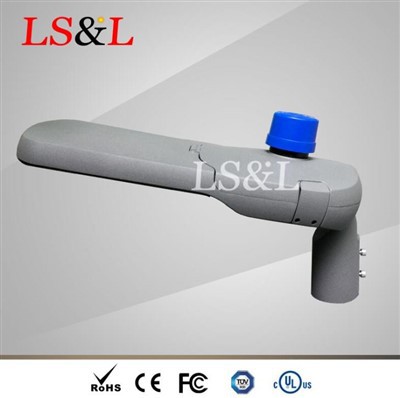
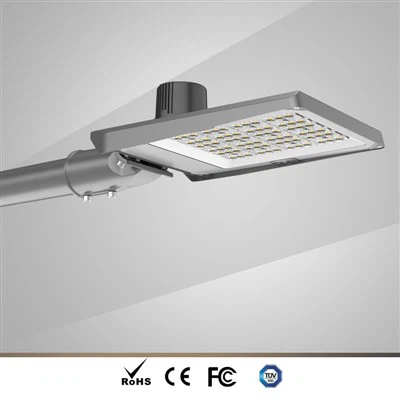
Frankly, after years in foreign trade, one of the questions I hear most often is whether smart dimming LED street lights are actually suitable for industrial parks. Some clients worry they are too expensive or too complicated; others are concerned about system stability. Looking at real projects, the answer is yes-they are suitable, and in most industrial settings the results are clearly better than ordinary LED lights.
Start with energy consumption. Industrial parks have a large number of fixtures along roads, parking lots, and internal pathways. Running them at full power all night adds up to a noticeable electricity bill. Ordinary LEDs already save more than traditional sodium lamps, but adding smart dimming can reduce consumption further. During low-traffic hours, the brightness can drop to 50–70% and automatically rise when vehicles or people appear. In many completed projects, the total lighting energy use fell another 20–30%. Some parks cut their lighting electricity costs by more than half after the upgrade, and smart dimming played a major role.
Safety becomes more flexible as well. Nighttime logistics, loading, and patrols all take place in industrial parks, and different zones have different brightness needs. Main roads require steady illumination, while secondary roads and parking areas can use motion-activated lighting. Smart dimming allows strategies based on zone, time, and traffic volume-keeping critical areas bright while avoiding constant high output across the entire site. Drivers and security staff consistently report better visibility and a stronger sense of safety.
Maintenance and management bring another practical advantage. Systems with remote monitoring show the real-time status of every fixture and locate faults immediately, instead of waiting for a patrol to discover them. Fixtures in industrial parks are widely scattered, so traditional troubleshooting is time-consuming. With an intelligent platform, maintenance efficiency rises significantly. Some parks also link the data to their existing energy-management systems, making consumption tracking and green-factory reporting much easier.
Of course, it is not a case of simply installing the system and expecting perfect results. Smart dimming LED street lights place certain demands on network coverage and power stability. If signal coverage is poor or voltage fluctuates heavily, communication can become unstable. When selecting products, confirm the communication methods the fixtures support (power-line carrier, LoRa, 4G, etc.) and whether the supplier has genuine experience in industrial environments. The initial investment is higher than that of basic LEDs, but once electricity and maintenance savings are factored in, the payback period usually stays within a reasonable range.
One point that is often overlooked is light pollution and impact on the surrounding area. Some industrial parks sit close to residential or ecological zones, and running lights at full power all night can generate complaints. Smart dimming can automatically lower brightness in the early hours, reducing unnecessary spill light and making the site more neighbor-friendly.
Those of us in foreign trade have worked on industrial park projects across Southeast Asia, the Middle East, and China. Where smart dimming was properly applied, client feedback has consistently been better than with simple lamp replacement. The key is matching the solution to actual needs-neither adding "smart" features for their own sake nor choosing an overly complex system that cannot be maintained.
If your industrial park is considering a lighting upgrade and you want to confirm whether smart dimming LED street lights are the right fit-or if you need energy data and practical experience from similar projects-just get in touch. I can share which strategies work in real conditions and which pitfalls to avoid. Choose correctly, and both energy savings and safety can be achieved together.