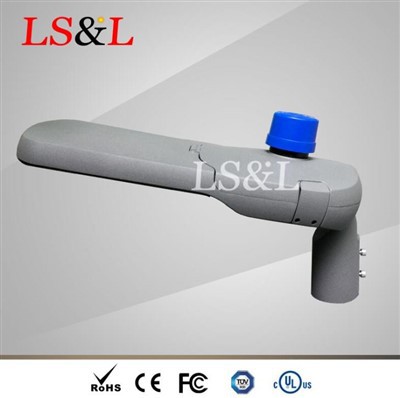
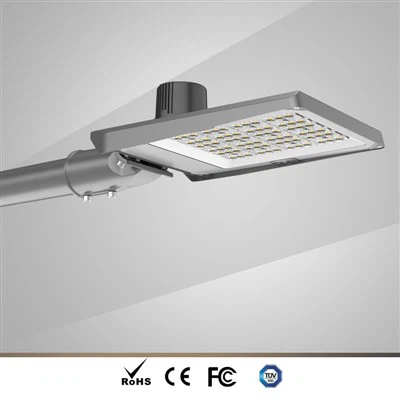
In daily lighting projects and outdoor road applications, many clients frequently ask a practical question: Can LED street light heads be directly connected to household electricity? As a long-time foreign trade professional specializing in LED lighting, I have worked with numerous overseas buyers and project contractors, and this question comes up repeatedly. The answer is clear: standard LED street light heads generally cannot be connected directly to household power and must be matched according to the specific voltage and driver design.
Why Cannot LED Street Lights Be Directly Connected to Household Mains Power?
LED is a low-voltage light-emitting device. The typical operating voltage of an LED chip is around 2–3.5 V, while complete LED street light systems usually run on 12 V, 24 V, or 36 V DC. Household mains electricity (110 V or 220 V AC in most countries) is far higher than the safe working range of LEDs. Direct connection can burn out the driver or chips at best, or cause short circuits and even fire hazards at worst.
Therefore, proper LED street lights must use a constant-current driver or transformer for voltage step-down and current limiting. This is a basic industry safety requirement and a point we repeatedly emphasize in export certifications such as CE, RoHS, and IEC. Ignoring it not only shortens product lifespan but also creates risks for the end project.
Basic Structure of LED Lamps and Their Anti-Vibration Advantages
LED stands for Light Emitting Diode. Its core is a semiconductor chip that emits light when electrically excited. The chip is fixed to a support with silver or white adhesive, connected to the circuit board via gold or silver wires, sealed with epoxy resin for protection, and finally fitted with a housing.
This structure delivers excellent anti-vibration performance. Compared with traditional high-pressure sodium or metal halide lamps, LED street lights remain more stable during transportation, installation, and long-term outdoor vibration. This is one of the key reasons more municipal and industrial projects are switching to LED solutions.
Which LED Lamps Can Be Directly Connected to Household Electricity?
It is important to distinguish here: standard E27 or E14 base household LED bulbs and downlights already incorporate a built-in step-down and current-limiting circuit (driver), so they can be plugged directly into 110 V/220 V mains.
Street light heads are different. Most professional LED street lights use modular designs with external or internal constant-current drivers, and the input voltage must match the specification exactly. Some wide-voltage models offer a broader input range, but operation should still follow the product datasheet-never attempt unauthorized modifications. In foreign trade orders, we always ask clients for local grid voltage details so the correct driver can be matched.
Practical Purchasing Notes and Experience Sharing
From years of export experience, voltage mismatch remains one of the main causes of after-sales issues. The correct approach is:
Confirm that the luminaire's rated input voltage matches the local grid;
Check whether a waterproof driver is supplied as standard;
Ensure proper grounding and lightning protection during installation.
Long-tail keywords such as "risks of connecting LED street lights directly to household power," "LED street light voltage matching," and "E27 LED bulb vs street light driver" are commonly used by clients in searches. Clarifying these details in advance greatly reduces later disputes.
Conclusion
Luxsky Lighting has always insisted on high-quality LED street light production. From chip selection and driver matching to waterproof structure, every detail is strictly controlled. Our products are stable and reliable, and we have served many overseas municipal and engineering clients. Buyers with requirements are welcome to contact us for detailed specifications and sample support, and to choose professional LED street light solutions that match local grid conditions.