I. Core Lighting Indicators
Brightness and Uniformity
Modern street lights achieve uniform illumination through optical design. Mainstream LED street lights provide 20-50 lux at a height of 5-10 meters, meeting nighttime road safety requirements. However, careful consideration should be given to matching the luminaire's light distribution curve with the installation spacing to avoid overlapping light spots or dark areas.
Color Temperature and Color Rendering
LED street lights typically use a warm white light temperature of 3000K-4000K, balancing eye comfort and legibility. Their color rendering index (Ra) is generally above 70, surpassing traditional high-pressure sodium lamps (Ra≈20), enabling more realistic color reproduction.
Glare Control
UGR (Ultra-High Glare Index) can be controlled below 19 (international standards) through grille shades and light-cutting fixture designs. However, optimization should be considered based on the installation angle (recommended luminaire elevation angle ≤15°) and ambient reflectivity.
II. Key Factors Affecting Performance
Environmental Reflection
Concrete pavement has a reflectivity of approximately 20%, while asphalt pavement has a reflectivity of only 5%-10%. It is recommended to increase the density of lamps or increase the light source power in low-reflectivity areas.
Installation Parameters
Suspension Height: 8-12 meters recommended for main roads, 4-6 meters for branch roads.
Spacing: LED streetlight spacing = (0.3-0.5) × suspension height.
Tilt Angle: The elevation angle of road lighting fixtures is generally ≤15°.
Maintenance
Dust accumulation on the lampshade can cause a 30%-50% decrease in luminous flux; quarterly cleaning is recommended. The LED driver power supply failure rate is approximately 1.5% per year and requires regular inspection.
III. Typical Application Scenarios
Urban Main Roads
Symmetrical lighting on both sides with an illumination of ≥20 lux, a color rendering index (Ra) ≥70, and a glare index (UGR) ≤19 ensures safe driving.
Sidewalks/Plazas
Use light-cutting lamps with an illumination of 8-15 lux, a color temperature of 3000K, and a glare index (UGR) ≤16 to create a comfortable walking environment.
Tunnel Lighting
The illumination at the entrance must be at least three times that of the exit, and a gradient dimming solution should be used to prevent visual adaptation difficulties.
IV. Future Development Trends
Intelligent Control
Dynamic dimming technology based on vehicle and pedestrian flow can achieve energy savings of over 40%, with some pilot projects achieving energy savings exceeding 90%.
Multimodal Integration
New streetlights integrate 5G base stations, environmental monitoring, and charging stations, reducing per-lamp costs by 20% and improving O&M efficiency by 30%.
Light Health Research
Research shows that color temperatures below 4000K can reduce the harmful effects of blue light. New full-spectrum LED streetlights are currently undergoing testing, with a target Ra ≥ 90.
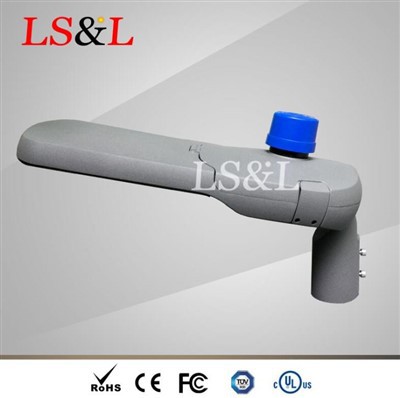
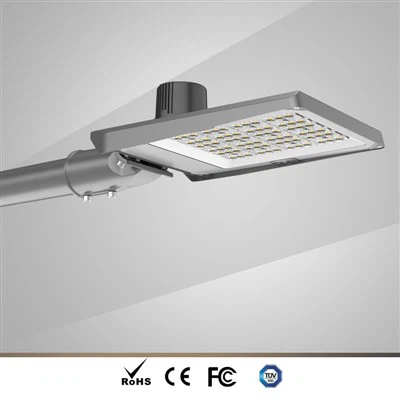
Luxsky light's new street light performs well and is worth buying.