After more than a decade in lighting exports, factory and project clients often send a datasheet and ask which numbers really matter. The tables are long; focusing on the wrong line is an easy way to buy the wrong lamp. Here is a practical way to read an industrial bulkhead datasheet, based on field experience.
Start with Electrical and Supply Conditions
Check rated power, input voltage range, power factor and driver type. Confirm the voltage covers the site (for example 220–240V or a wide range) and that power factor meets the project brief. These points decide whether the lamp can drop in and whether it will run efficiently.
Electrical data for an LED bulkhead light should match the existing distribution so deliveries are not held up by voltage or wiring mismatches.
Then Read Optical Data: Lumens, Efficacy, CCT and CRI
Luminous flux (lm) and efficacy (lm/W) show how much light you get and how hard the lamp works for it. CCT and CRI affect colour appearance and recognition. Industrial routes often use 4000K or 5000K; where colour judgment matters, CRI should not be too low.
Do not rely only on the highest lumen claim-read it with the distribution and mounting height to judge uniformity on the floor and vertical surfaces.
Protection and Environment: IP, IK and Temperature
In dusty or humid zones, prioritise IP; on routes with impact risk, check IK as well. The ambient temperature range shows whether the luminaire can run stably in a hot workshop or a cold store.
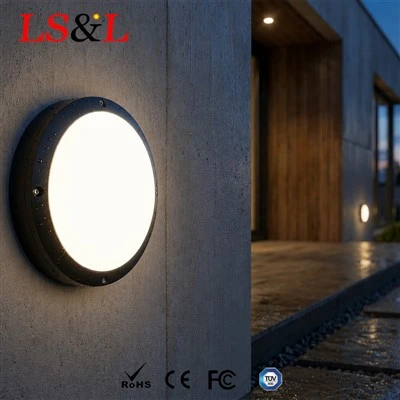
For semi-outdoor or exterior-wall points, assess weathering and sealing as outdoor bulkhead light duty-do not rely on an indoor IP figure alone.
Lifetime, Materials and Mounting
Lifetime is often given as L70 or L80 hours with test conditions stated. Housing and diffuser materials, weight, cut-outs and mounting method (wall or ceiling) affect install effort and later maintenance.
When a round bulkhead light is used to standardise a route, also check overall size so it can replace older fittings without bracket conflicts.
A Practical Order for Reading the Sheet
- Electrical: voltage, power, power factor
- Optical: lumens, efficacy, CCT, CRI, distribution
- Environment: IP, IK, operating temperature
- Construction: dimensions, weight, mounting, materials
- Certificates and warranty: match them to the project
An industrial LED bulkhead datasheet is a selection checklist, not a brochure. Reading in the order electrical → optical → protection → construction quickly shows whether the product fits the workshop or route.
From years of working with factory and export clients, I know buyers who can read a datasheet avoid half the usual mistakes. Numbers must match the site-not only the most attractive maximum values.

If you are comparing several bulkhead datasheets, share the key figures or site conditions. I can help identify which bulkhead light fits better and mark the lines you must verify.