

Cold storage warehouses feature dense racking and large temperature differences, which often create bright and dark zones. Uneven lighting reduces order-picking efficiency and brings potential safety hazards. Having worked on many overseas cold chain projects, I've summed up practical methods to help clients boost lighting uniformity in cold storage warehouses.
1. Complete photometric simulation in advance and control fixture spacing & mounting height
Many clients arrange lights by experience, only to find heavy shadows along rack aisles after installation. For cold storage lighting layout, keep the ratio of fixture spacing to mounting height at 1.0–1.5 to ensure overlapping light beams. For narrow and long aisles, select lights with optimized light distribution to balance ground illuminance and vertical illuminance on rack surfaces, rather than focusing merely on ground brightness. Request IES files for lighting simulation at the early project stage to predict dark areas beforehand.
2. Select weatherproof LED batten lights tailored for cold storage environments
Lenses of ordinary lights are prone to frost and fogging, which gradually cuts light transmittance and worsens uniformity over time. Cold storage needs linear fixtures with reliable sealing, low-temperature resistance and anti-condensation features, whose lenses can resist frost aging. Install linear lights lengthwise along aisles. Compared with single-point high bay lights, they create continuous and even light strips and reduce zebra-like alternating light and shadow, ideal for cold storage with multi-layer dense racks.
3. Pick the proper beam angle to minimize shadows
Narrow beams suit high racks for long-distance lighting but may cause local over-brightness. Wide beams deliver broader coverage yet are likely blocked by racks in high spaces. Cold storage with low ceilings should prioritize wide-angle diffuse lenses with soft covers to reduce glare. For high-rise automated warehouses, asymmetric aisle-specific optical lenses can direct light onto rack label surfaces to ease barcode scanning during picking.
4. Maintain fixtures regularly to prevent light loss caused by frost
Alternating hot and cold conditions in cold storage lead to frost and dust buildup on lenses. Even a well-designed lighting scheme will suffer poor uniformity after long-term use. Include lens cleaning in routine cold storage maintenance to clear frost and check for aging seals. Choose fixtures with frost-resistant housings during selection to lower long-term maintenance workload.
5. Add supplementary lighting to illuminate dark corners
Main lights often fail to cover corners, cold storage doorways and top rack areas. You may add a small number of auxiliary fixtures to fill low-illuminance spots. IP65 LED tri-proof light is a great option, with dustproof and moisture-proof performance to withstand high humidity brought by frequent defrosting in cold storage. Auxiliary lights do not require high wattage; they only balance illuminance gaps without sharply raising overall power consumption.
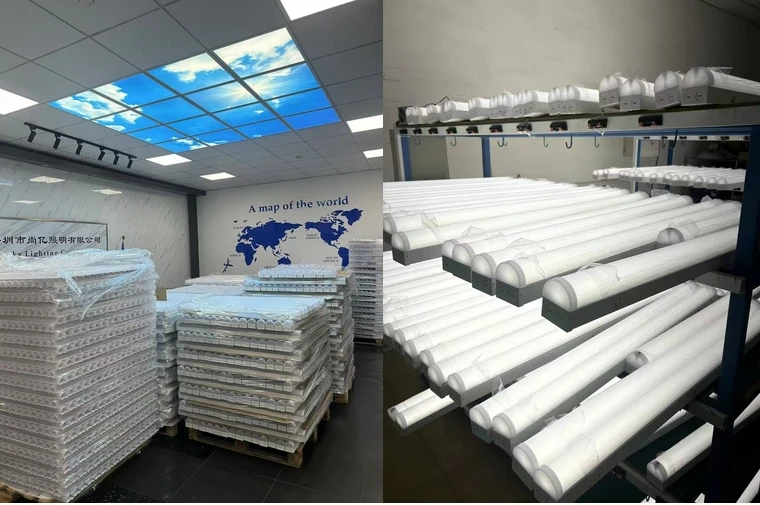
Improving cold storage lighting uniformity is not simply increasing fixture wattage. It relies on the combination of light distribution, layout and fixture selection. We have delivered numerous overseas cold chain projects and can provide professional lighting solutions based on your warehouse dimensions, rack layout and minimum operating temperature. If you are planning new cold storage construction or lighting renovation, feel free to send us your warehouse drawings for free lighting layout recommendations on tri proof lights.





