

Uneven coverage is a common warehouse lighting problem. Bright centres with dark edges, heavy shadows under racking and dim spots at aisle junctions all reduce efficiency and safety. Tri-proof lights are widely used, yet only correct positioning lets them deliver truly even coverage. Here's practical advice from site experience.
Clarify the coverage goals
- Different zones need different light.
- Main aisles and picking areas require higher, uniform illuminance.
- Racking zones need adequate vertical light for label reading.
- Loading areas must minimise shadows for clear forklift visibility.
Clear targets guide the layout.
Get mounting height and spacing right
Height determines how far each light reaches; spacing controls overlap and uniformity. Mounting too high with wide spacing often creates bright centres and weak edges; mounting too low and tight can cause glare and waste. In medium-height warehouses, tri proof lights are commonly spaced at 1 to 1.5 times the mounting height, then adjusted for actual lumen output and optics.
Pay attention to orientation and arrangement
Linear fixtures aligned with the aisle direction give better continuity and reduce cross-shadows. In racking areas the lights can run parallel or perpendicular to the racks depending on height and aisle width. A well-specified LED tri proof light with suitable light distribution, combined with the right layout pattern, noticeably improves overall uniformity.
Prioritise critical zones
Intersections, turning points and loading platforms see heavy traffic and higher risk of dark spots. Slightly tighter spacing or adjusted aiming helps in these locations. Check the lowest rack levels and aisle edges-these are often under-lit if not deliberately considered.
Account for obstructions early
Pipes, ducts, signs or high racking can block light. Confirm obstacle locations on site before finalising positions and adjust points or add local supplementary lighting where needed. In dusty environments it is wise to build in a modest output margin even when using well-protected fixtures.
Plan by zone, then select
Long aisles suit continuous runs of a weatherproof LED batten light for smooth light connection. Larger open areas work well with grid or row arrangements. Where possible, trial a small section on site-real uniformity and shadow patterns are more reliable than drawings alone.
Good positioning delivers more even brightness, supports safer and faster work, and reduces the need for later additions.
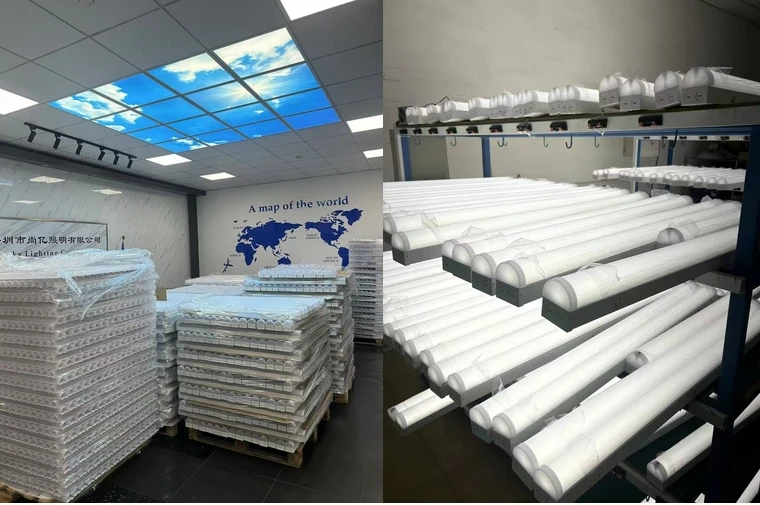
If you are planning a warehouse layout or currently have noticeable dark zones, share the mounting height, main zone types and specific issues. I can help outline practical positioning approaches and key points based on similar projects. When the positions are right, coverage improves significantly.





