

After more than a decade in foreign trade, factory clients often compare LED tri-proof lights with LED tube lights and ask: "Which is actually better for factories?" Both are LED products, yet their positioning and suitable environments differ. Here is a clear comparison based on our daily shipments and client feedback.
In short, LED tube lights are closer to a direct replacement for traditional fluorescent tubes-easy to install and lower in initial cost. LED tri-proof lights, by contrast, are reinforced for harsh conditions. A proper LED triproof lamp has higher-level sealing, materials and circuit treatment.
Protection is the biggest difference
LED tube lights usually have lower protection ratings and are meant for dry, clean indoor spaces. Factory workshops are often humid and dusty; tubes easily collect dust or take in moisture, leading to poor contact or early failure. Tri-proof lights offer waterproof, dustproof and anti-corrosion performance. A common IP65 waterproof light rating fully seals against dust and resists low-pressure water jets, making them far better suited to real factory conditions.
Durability and maintenance cost
Tri-proof lights have more complete housing and sealing, so failure rates stay lower in damp or dusty environments and maintenance visits drop clearly. LED tube lights may cost less at the start, but in factories they need replacing more often, so total maintenance cost is often higher. Many logistics and storage clients choose a led warehouse light solution precisely for its stable, low-maintenance performance.
Different application areas
- LED tube lights: offices, clean workshops, ordinary corridors and other low-protection zones.
- LED tri-proof lights: processing workshops, warehouses, basements and areas with oil mist or mild corrosion.
Areas with explosion risks require a certified Explosion-proof linear light; neither type can simply replace it.
Efficacy and installation
Both can reach high efficacy, but tri-proof lights usually optimise optics and heat management for industrial use. Tube lights often fit traditional brackets; tri-proof lights use integrated or dedicated mounting, and some models support fast installation to cut labour time.
From our actual shipments, most manufacturing and warehouse factories ultimately prefer tri-proof lights. Food processing, machinery and auto-parts workshops report the clearest benefits: more stable lighting, fewer maintenance calls and lower long-term hassle. Market quality varies; housing material, seals and drivers decide real performance.
When choosing, first clarify workshop humidity, dust level and mounting method. Share the actual environment, ceiling height and requirements with us, and we can recommend the right product more accurately and help you avoid the wrong type.
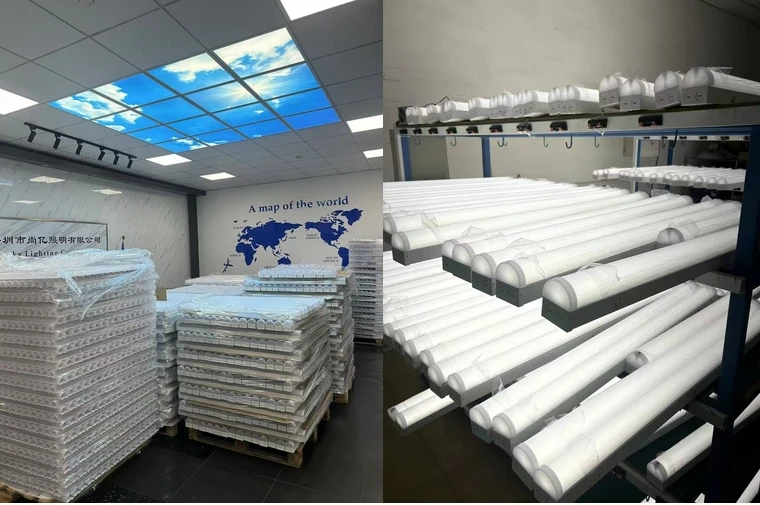
If you are comparing LED tri-proof lights with LED tube lights or want to confirm which suits your factory, leave a message or send an inquiry. We will match the more suitable LED tri-proof lights based on real shipment experience and help reduce trial-and-error costs.





