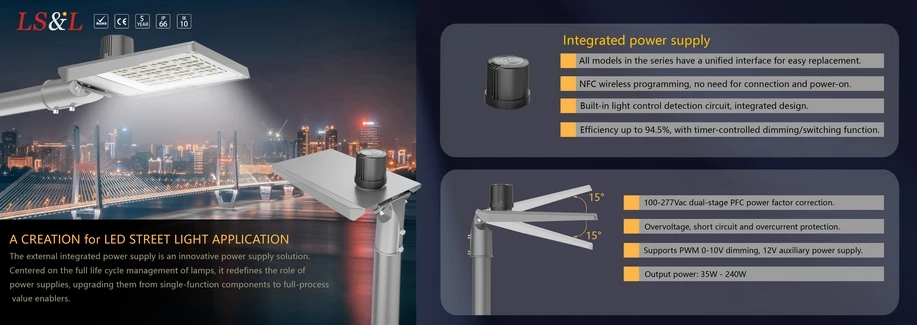
I've been exporting LED street lights for years now, and almost every week an overseas client asks me some version of the same question: "How far has LED street light technology actually come, and is there still room for improvement down the road?" Honestly, it's a fair question - clients naturally want to understand where the industry is headed before placing an order. Drawing on real project experience, I'd like to share my take on the current state of LED street lights and where the technology is heading.
Part 1: The Current State of LED Street Lights
1. Clear Energy Efficiency Advantage, Significant Energy Savings
Compared to traditional high-pressure sodium or metal halide lamps, LED street lights offer substantially higher photoelectric conversion efficiency, delivering brighter and more uniform illumination at the same wattage. In many of the municipal and road lighting retrofit projects I've worked on over the years, "energy savings" is consistently the top priority for clients. Mainstream LED street lights today typically achieve luminous efficacy of 130-160 lm/W, with some premium models exceeding 180 lm/W. Compared to traditional street lights, this translates to energy savings of 50%-70% or more - a compelling number for overseas clients who are sensitive to electricity costs.
2. Longer Service Life, Lower Maintenance Costs
Traditional street lights generally use tungsten filament bulbs or gas discharge lamps with a lifespan of around 8,000-15,000 hours, requiring frequent replacement. LED street lights, by contrast, use solid-state light sources with a normal service life exceeding 50,000 hours - some brands even reach 100,000 hours. That means a single installation can essentially run maintenance-free for over a decade, which is especially valuable for projects with difficult access or high maintenance costs, such as remote areas or mountain road lighting. Quite a few of the orders we receive from clients in Africa and the Middle East come down to exactly this point - reducing long-term labor and maintenance investment.
3. Strong Environmental Performance, Aligned with the Green Lighting Trend
Traditional mercury and sodium lamps contain harmful substances such as mercury and lead, which can cause environmental pollution once discarded. LED street lights contain no hazardous heavy metals and produce no UV or infrared radiation, making them a genuinely green lighting product. In recent years, markets like the EU and North America have tightened environmental certification requirements for imported lighting products - standards such as RoHS and REACH. LED street lights naturally meet these environmental thresholds, which is one of the key reasons they've been able to expand so rapidly in global markets.
Part 2: Future Development Trends for LED Street Lights
1. Photoelectric Conversion Efficiency Will Continue to Improve
Chip manufacturers and research institutions are continuing to invest heavily in R&D, working to further improve the photoelectric conversion efficiency of LED chips. It's reasonable to expect that LED street light efficacy will keep climbing steadily over the next few years, delivering stronger illumination at the same wattage and further reducing electricity costs. For large-scale municipal lighting projects and budget-conscious procurement teams, that's a genuinely meaningful benefit.
2. Smart, IoT-Connected Lighting Will Become the Mainstream Direction
With the growing adoption of IoT technology, smart LED street lights are becoming a major industry trend. Equipped with intelligent control systems, street lights can now support remote monitoring, automatic fault alerts, and adaptive dimming - automatically adjusting brightness based on traffic flow, weather conditions, or time of day, which both improves lighting efficiency and further reduces energy consumption. In recent years, we've seen a noticeable increase in inquiries from European and Australian clients regarding smart gateways and single-lamp controllers, which shows that smart street lighting is moving from concept to real-world deployment.
3. Application Scenarios Will Continue to Expand
Beyond traditional road lighting, LED street lights are increasingly being used in urban landscape lighting, park and plaza lighting, and industrial park lighting. Multi-functional integrated street lights - combining solar panels, EV charging points, and surveillance cameras - are also becoming standard features in some smart city projects, pointing to an even larger market opportunity ahead.
Conclusion: Built to Last - Luxsky Lighting Is a Choice You Can Trust
From energy efficiency and service life to environmental performance, the overall advantages of LED street lights are clear, and the future outlook is genuinely promising. At Luxsky Lighting, we've spent years focused on LED street light R&D and export, with strict quality control over core specs like luminous efficacy, thermal management, and IP protection ratings. Our products are stable and reliable, serving clients across the Middle East, Africa, Southeast Asia, and South America. If you're looking for a long-term LED street light partner, feel free to reach out - we'd be glad to provide a professional product solution and a competitive quote.