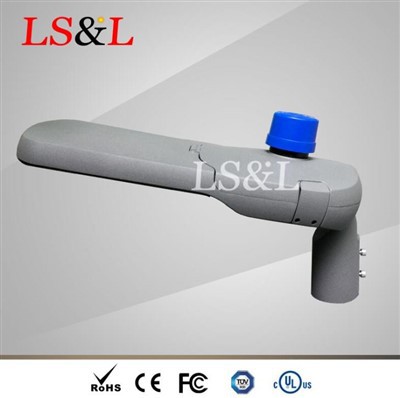
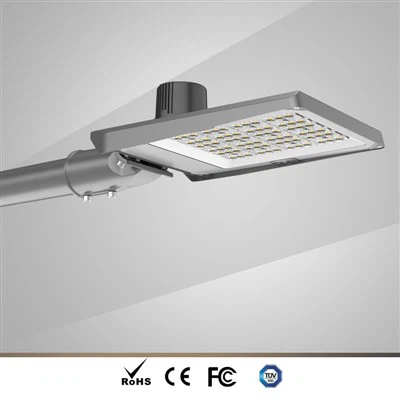
Having worked in the foreign-trade lighting export business for over a decade, one of the questions clients ask most often is: What power rating should I choose for LED street lights? Too low and the illuminance falls short; too high and you waste electricity while driving up costs. In reality, there is no single fixed "standard answer" for LED street-light rated power, yet the industry has already settled on relatively clear common specification ranges. Below I share the typical power tiers and selection logic based on real project experience.
Overview of Common Rated Power Tiers
The most frequently requested LED street-light powers in export markets currently center on 30 W, 40 W, 50 W, 60 W, 80 W, 100 W, 120 W, 150 W, 200 W and 250 W. Lower-power units (30–60 W) are mainly used for internal residential roads, sidewalks and park pathways; mid-range powers (80–150 W) cover urban secondary and primary roads; higher powers (200 W and above) appear on highways, interchanges or open areas that demand greater illuminance. Some projects fine-tune to non-standard values such as 180 W or 240 W according to pole height and road width, but the mainstream remains the integer tiers listed above.
Power Selection Must Match the Actual Application Scenario
Pole height is the first reference point. Poles of 6–8 m are usually paired with 30–80 W, 10–12 m poles with 100–150 W, and poles above 12 m tend toward 150–250 W. Road width, number of lanes, and required average illuminance (for example, 20–30 lx on primary roads) also directly influence the power choice. Many overseas clients initially focus only on the wattage number, only to discover later that the same 100 W can produce more than a 20% difference in actual road-surface illuminance depending on optical design, luminous efficacy and installation angle. This is precisely why we continually emphasize "Strict quality control LED engineering lighting"-rigorous quality control from chip selection and driver power supply through to full-luminaire efficacy testing ensures that the rated power truly converts into effective illumination.
The Relationship Between Luminous Efficacy and Actual Power Consumption Matters More
Today's high-quality LED street lights typically achieve 130–160 lm/W, with some engineering-grade products exceeding 180 lm/W. Under the same illuminance requirement, higher efficacy means lower required rated power. For instance, a primary road that once needed 150 W can now meet the standard with a 120 W high-efficacy product, saving electricity while also reducing transformer and cable costs. Among long-tail keywords, clients frequently search for "high-efficacy LED street light power selection" and "common wattages for energy-saving municipal street lights"-all of which point to the same core insight: power is only the starting point; system efficacy and long-term maintenance stability deliver the real value.
Practical Advice from Export Projects
In years of foreign-trade work, I have seen too many cases where an incorrect power choice led to later complaints. I recommend that clients first provide pole height, road cross-section drawings, and local lighting standards so the appropriate power can be calculated in reverse. At the same time, pay attention to the constant-current accuracy of the driver and the power factor of the complete luminaire-these details directly affect actual consumption and grid compatibility. A strict quality-control system keeps power deviation within a very tight range, avoiding hidden over-consumption such as a "rated 100 W that actually runs at 115 W."
Overall, the common rated-power specifications for LED street lights are already relatively mature, covering the vast majority of applications from 30 W to 250 W. The key is to match the power to site conditions and efficacy level rather than simply chasing higher wattage.
Conclusion
Our Luxsky Lighting LED street lights undergo rigorous testing for power accuracy, efficacy stability and overall reliability, and have received consistent positive feedback from markets in multiple countries. If you are matching the right LED street-light power specification for your project, please contact us directly for detailed parameters and sample support.