In foreign trade inquiries, clients often ask directly: What is the output voltage of an IP65 LED street light? Many people mix up "output voltage" with "input voltage" and also tend to link the protection rating with the voltage standard. As a sales professional with over a decade of experience in this industry, I have worked on numerous projects across Europe, the Middle East, and Southeast Asia. Below, I clarify this issue according to actual product logic.
First, Distinguish Between Input Voltage and Output Voltage
An LED street light itself does not directly "output 220V." What connects to the mains is the input side of the driver. The driver converts AC mains power into low-voltage DC or constant-current output suitable for the LED chips. Common driver output voltages are 12V, 24V, 36V, or 48V, or direct constant-current output (such as 700mA or 1050mA), depending on the series-parallel design of the internal LED modules.
When clients say "output voltage 220V," they usually mean the input voltage. In China and most countries/regions using a 220-240V grid, the rated input voltage of LED street light drivers is 220V or 220-240V. In parts of Europe and North America, wide-voltage designs of 110-277V are common, allowing the same product to adapt to different markets.
IP65 Protection Rating Has No Direct Relationship with Voltage
IP65 is a protection rating code: 6 means completely dust-tight, and 5 means protection against low-pressure water jets. It only indicates the dust and water resistance of the luminaire housing and has no necessary connection with the numerical value of the input or output voltage. Whether the input is 220V or wide-voltage, as long as the structural sealing is properly done, the product can achieve IP65 or even higher. Many clients mistakenly believe that "IP65 equals 220V," which is a conceptual confusion.
Common Voltage Ranges in Actual Products
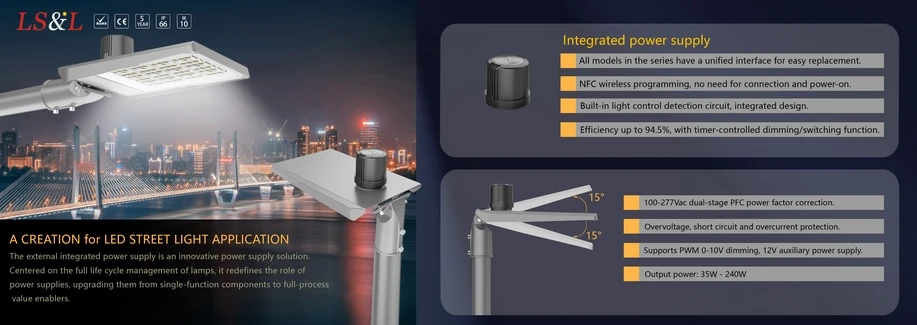
Quality LED street light drivers usually support a certain input voltage fluctuation range, such as 180-265V or 100-277V, to cope with unstable grid conditions. The output side is designed according to the LED chip requirements to ensure constant-current or regulated voltage output, preventing voltage fluctuations from causing lumen depreciation or damage. In Middle East and African projects, we particularly emphasise wide-voltage and surge-protection designs because local voltage fluctuations are large and ordinary narrow-voltage drivers can easily fail.
When selecting products, do not look only at the single figure "220V." Also confirm:
- Whether the input voltage range matches the local grid
- Whether the output is constant-voltage or constant-current
- Whether the driver has over-voltage, over-current, and lightning protection
- Whether the whole luminaire truly reaches IP65 and has been tested
These details directly determine the stability and lifespan of the product in the project.
Practical Advice for Foreign Trade Projects
When exporting to different countries, voltage standards vary greatly. Europe is mostly 230V, North America commonly uses 120V/277V, and the Middle East and Southeast Asia mainly use 220-240V. Choosing drivers that support wide-voltage input can reduce inventory and customisation costs. At the same time, IP65 is only a basic protection level; for coastal or high-humidity areas, higher protection and anti-corrosion materials should also be considered.
Conclusion
Luxsky Lighting's LED street lights use high-quality wide-voltage drivers and reliable sealing structures, offering strong input voltage adaptability and stable protection ratings of IP65 and above. If you need to confirm specific voltage parameters or project adaptation solutions, please contact us directly for detailed information.