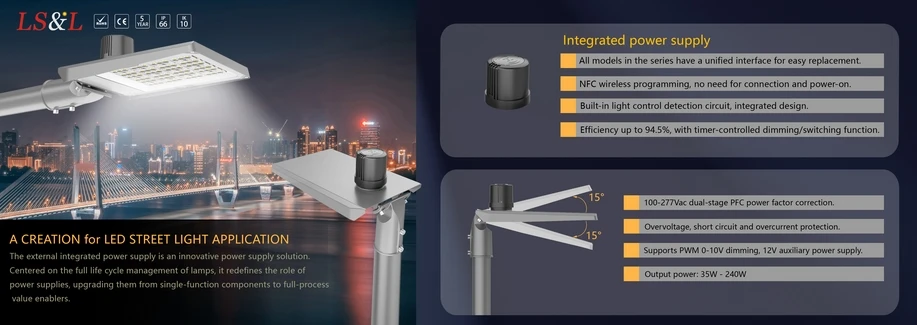
Having worked in the foreign-trade lighting export sector for over a decade, one of the parameters clients focus on most when requesting quotes is overall luminous efficacy. Many people still confuse chip efficacy with system efficacy, only to find that actual power consumption and illuminance do not match after purchase. Today I will use solid practical experience to clarify the common levels of LED street-light system efficacy and what truly qualifies as high-efficiency.
Current Market Range of Overall Luminous Efficacy
At present, the overall luminous efficacy of export-oriented LED street lights mostly falls within the 120–160 lm/W range. Entry-level products typically sit at 110–130 lm/W, mid-tier engineering-grade units commonly reach 130–150 lm/W, and products that can stably achieve 160 lm/W or higher already belong to the high-efficacy category. Some solutions using the latest-generation chips combined with precision optics can push system efficacy to 170–190 lm/W, with a few laboratory-level designs even breaking 200 lm/W-yet mass-production stability and cost control remain the decisive factors. Long-tail keywords clients frequently search, such as "high-efficacy LED street light lm/W standard" and "overall luminous efficacy of energy-saving municipal street lights," ultimately ask the same question: what level truly counts as high-efficiency?
What Counts as High-Efficiency? Focus on the System, Not a Single Point
Looking only at the chip's nominal efficacy is meaningless; overall luminous efficacy is the final real-world indicator. It equals the total luminous flux of the luminaire divided by actual input power, and therefore incorporates LED chip performance, driver efficiency, secondary optical losses, and thermal-management losses. Driver efficiency below 90 %, poor lens transmittance or inadequate heat dissipation will immediately drag down even a high-efficacy chip. This is exactly why we continually emphasize "Strict quality control LED engineering lighting"-rigorous quality control from chip binning and constant-current driver accuracy through to full-luminaire aging tests ensures that the rated efficacy is genuinely delivered in actual projects.
Practical Value Delivered by High Efficacy
Under the same illuminance requirement, raising overall efficacy from 130 lm/W to 160 lm/W means the required power can be noticeably reduced, simultaneously cutting electricity, cable, and transformer costs. Many overseas municipal projects report that full life-cycle costs drop 15–25 % after switching to high-efficacy products. For export clients, efficacy stability and lumen-maintenance control are equally important. Quality products still retain a high lumen-maintenance factor after 50 000 hours, whereas low-end products suffer faster lumen depreciation and greater risk of failing to meet illuminance standards later.
Practical Selection Advice
In years of foreign-trade work, I have seen too many cases that chase "ultra-high efficacy" while ignoring the driver and thermal design. I recommend that clients ask suppliers for complete IES files and third-party efficacy test reports, while also paying attention to power factor, harmonics, and actual operating temperature. A strict quality-control system keeps efficacy deviation within a very tight range, avoiding the embarrassment of a "rated 160 lm/W that measures only 140 lm/W."
Overall, the mainstream overall luminous efficacy of LED street lights currently lies between 130 and 160 lm/W, with 160 lm/W and above regarded as the high-efficiency level. What truly matters is stable system output rather than paper numbers.
Conclusion
Our Luxsky Lighting LED street lights undergo rigorous testing for overall luminous efficacy, power accuracy, and long-term stability, and have received consistent positive feedback from markets in multiple countries. If you are looking for a high-efficacy, reliable LED street-light solution, please contact us directly for detailed parameters and sample support.