

Many overseas clients ask about the required lux level for cold storage at the early stage of projects. Illuminance is not always better when higher; zoning settings are key to balancing safety, operational efficiency and electricity cost. Having handled dozens of overseas cold chain projects, I will share industry-standard illuminance references and practical implementation tips below.
1. Recommended illuminance standards for different cold storage zones
According to international warehouse lighting codes, target lux values vary greatly across working areas. For bulk static storage zones with infrequent cargo handling, 100–150 lux is sufficient to support forklift movement and basic identification. Regular picking aisles, as high-frequency working zones, are recommended for 200–300 lux to quickly read shelf labels. For quality inspection, packaging and receiving docks where documents and goods need checking, the illuminance should be 300–500 lux. One important reminder: frost in cold storage continuously reduces light output. Reserve a 15%~25% margin for illuminance depreciation during design.
2. Select fixtures compatible with low-temperature conditions, LED tri proof lamp is recommended
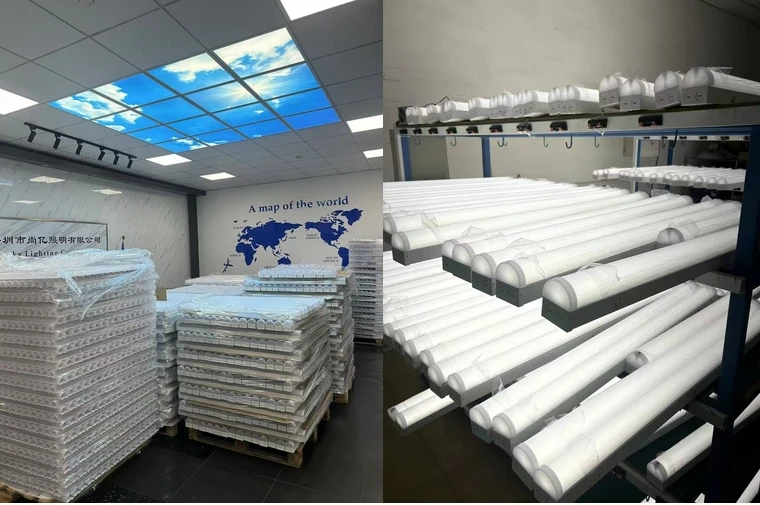
Even if the calculated illuminance meets requirements on paper, brightness will drop sharply after operation if the lights cannot withstand low temperatures. Cold storage features high humidity and drastic temperature swings. Ordinary LED lights suffer from condensation and rapid lumen depreciation. This fixture boasts reliable sealing and stable performance under sub-zero temperatures, maintaining consistent illuminance long-term and avoiding frequent replacements caused by insufficient brightness later.
3. Do not overlook vertical illuminance; ground lux alone is not enough
Many clients only calculate horizontal ground illuminance for lighting plans and ignore rack surfaces. Cold storage usually has tall racks with labels attached to shelf facades. Poor vertical illuminance makes barcodes unreadable even with bright floors. Choose proper light distribution during layout to illuminate rack facades. When on a tight budget, you may add weatherproof emergency light. It provides regular basic lighting and ensures personnel evacuation during power outages, complying with overseas site safety regulations.
4. Meeting lux requirements does not guarantee a qualified solution; schedule regular maintenance
Frost and dust easily build up on lenses of cold storage fixtures, causing gradual lumen loss. Routine maintenance helps sustain the designed lux level over time. Prioritize fixtures with frost-resistant housings that are easy to clean. For warehouses with long continuous aisles, linear arrangement of weatherproof lights delivers more even illuminance distribution, reduces dark spots and cuts picking errors.
Cold storage illuminance design requires zoning planning. It needs comprehensive calculation considering rack layout, minimum ambient temperature and local safety standards, instead of directly adopting general warehouse specifications. We can run free lighting simulation based on your cold storage drawings to figure out the right quantity and layout of fixtures. If you are preparing for new cold storage construction or lighting renovation, feel free to contact us for professional solutions.





