

With years of industrial lighting export experience, I have handled countless overseas factory construction and renovation projects. Many engineering buyers struggle with fixture protection‑rating selection. Some over‑specify high ratings and inflate budgets, while others choose low‑protection cheap products, leading to frequent water ingress, dust accumulation and short‑circuit repairs later.
Protection standards vary for workshops and warehouses. Proper rating selection guarantees long‑term stable fixture performance while controlling project costs. Below is practical guidance based on real‑world engineering cases.
1. Why protection ratings matter for industrial fixtures
Ordinary indoor lights are only suitable for dry, dust‑free environments. Factories are exposed to dust, moisture, condensation and mild corrosive fumes. Poor‑sealed low‑rating fixtures suffer rapid light decay, flickering and driver burnout.
For genuine industrial applications, LED triproof lamp with well‑designed sealed housings is widely adopted to cope with harsh factory conditions and reduce maintenance workload.
2. Differences among common industrial IP ratings
IP40, IP54 and IP65 are mainstream options for industrial lighting.
IP40 offers basic dust resistance without water‑proof performance, only for dry clean workshops.
IP54 resists limited dust and water splashes for mild‑industrial environments.
As the widely‑used golden standard for overseas industrial projects, IP65 waterproof light delivers full dust protection and withstands multi‑angle high‑pressure water jets, fitting most dusty and humid production sites.
3. Protection‑rating guidance for different factory zones
Production workshops
IP65 delivers reliable long‑run performance and great cost‑efficiency for regular assembly and processing workshops with dust exposure and occasional floor washing.
Warehouse and logistics areas
Warehouses feature heavy dust buildup and occasional humidity. led warehouse light is recommended with IP65 rating to block dust and moisture for stable non‑stop warehouse illumination.
Special high‑risk conditions
Higher IP ratings cannot solve safety risks caused by flammable‑explosive gas, dust or chemical vapors. Standard tri‑proof lights are not qualified; certified explosion‑proof lighting must be deployed instead.
4. Common purchasing mistakes
Many buyers assume higher IP ratings always mean better performance and blindly pick IP67 or IP68, causing unnecessary budget waste. IP65 already provides sufficient protection for most ordinary factories. Others cut costs by selecting IP40 or IP54. Short‑term savings are offset by high later‑stage repair and replacement expenses. Matching ratings to actual working conditions remains the most cost‑effective engineering principle.
IP65 offers balanced dust‑proof, water‑proof and moisture‑proof performance for the majority of workshops and warehouses. Upgrade to higher‑rated or explosion‑proof fixtures only for submersion‑prone, heavily‑corrosive or hazardous sites.
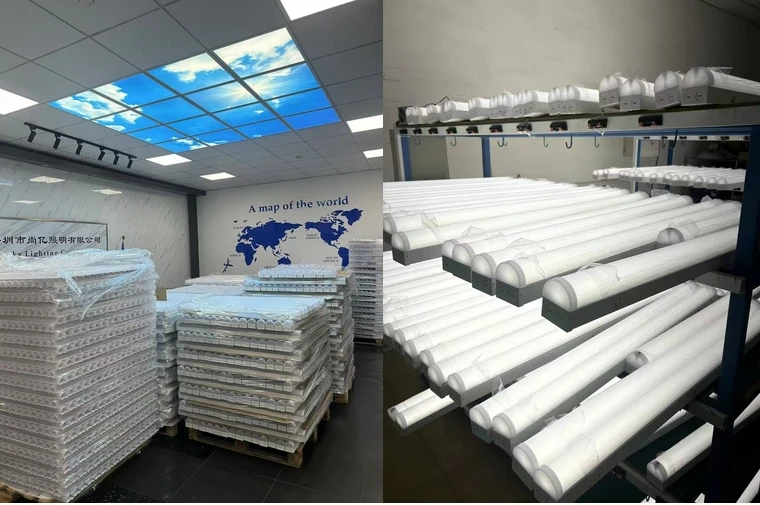
Familiar with global industrial lighting acceptance standards, we can suggest proper fixture specifications according to your site environment and installation requirements. Feel free to contact us for selection guidance, parameter checking and bulk quotations for your customized industrial lighting solution.





