What an IP Rating Actually Promises
Every outdoor luminaire carries a two-digit IP code, and the digits are not interchangeable. The first describes protection against solids; the second against water. IP65 means dust-tight with resistance to water jets, IP66 adds heavier seas and high-pressure washing, and IP67 promises temporary immersion. Matching the number to the installation is the cheapest reliability decision a buyer will ever make, yet mismatched ratings remain a leading cause of warranty disputes.
Context matters as much as the code itself. A luminaire sheltered under an eave, a fixture bolted to a bridge pier, and a buried in-ground uplight face completely different water challenges. Specifiers who blanket every position with the highest available rating often pay for protection the installation never demands, while under-specifying a washdown zone or a coastal exposure site practically guarantees early failure and an unhappy end client.
The verification step is equally simple and frequently skipped. Request the test report behind the marking, not just the marking itself: legitimate IP certificates name the exact product variant tested, the laboratory, and the date. Reports that cover a whole product family in a single page deserve follow-up questions, because gasket geometry often changes between wattages and lens options.
Thermal Design: The Silent Specifier of Lifespan
Heat, not water, kills most LED installations quietly. Junction temperature governs both lumen depreciation and driver longevity, and the gap between a well-engineered thermal path and a marginal one can halve useful life. Always ask manufacturers for the thermal derating curve, which shows how output behaves as ambient temperature climbs. A fixture that only meets its photometric claims in a 25-degree laboratory will disappoint on a sun-baked factory roof in August.
Good thermal engineering shows itself in physical details: finned housings with vertical chimneys that shed heat by convection, thermal interface materials bonding the LED board to the body, drivers mounted away from the LED chamber, and honest maximum ambient ratings of 40 degrees Celsius or higher. Every one of these can be verified in a sample teardown before you commit to a full container order.
Where Sealing and Cooling Fight Each Other
Sealing and cooling pull in opposite directions, which is exactly what makes outdoor fixture design genuinely difficult. A heavily gasketed or potted enclosure resists water beautifully but traps heat; an aggressively finned body rejects heat but multiplies the seams where moisture can enter. Resolving that tension is the core engineering task, and it explains why a reputable manufacturer's outdoor range takes years rather than months to develop.
Look for pressure-equalization vents, which let the enclosure breathe through a waterproof membrane as internal temperatures cycle. They suppress the pump effect that otherwise draws moisture through sound seals over thousands of day-night transitions. Combined with marine-grade fasteners and gasket materials chosen for the actual climate, they are the quiet difference between a facade that stays bright and one that streaks with condensation after its first winter.
Luxsky Product Perspective
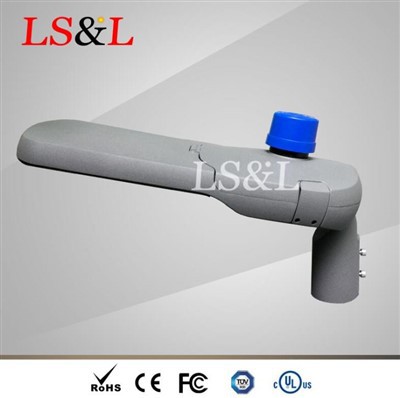
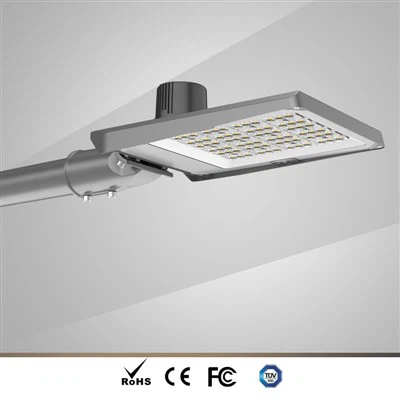
We design our outdoor families around exactly this balance. Our LED flood lights pair sealed IP66 optical chambers with generously finned rear housings, documented for high-ambient operation rather than laboratory conditions. Our LED street lights are rated IP66 with 10kV surge protection as standard, and IP65 versions of our LED linear lights cover exposed soffits, underpasses, and car parks.

If your site conditions sit outside the ordinary, coastal salt spray, desert heat, or high-altitude ultraviolet exposure, send us the environment details. We will match enclosure, gasket, and thermal specification to the real climate rather than a generic catalogue page, and share the derating data so your maintenance planning starts from reality rather than optimism. That is what a lighting partner should do before the order, not after the failure.