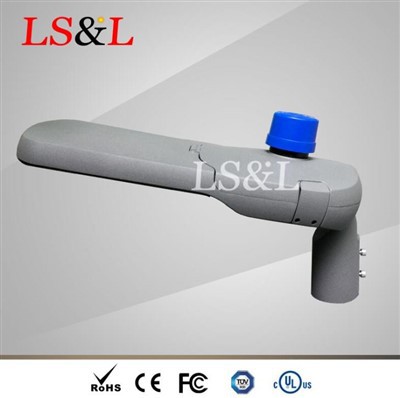
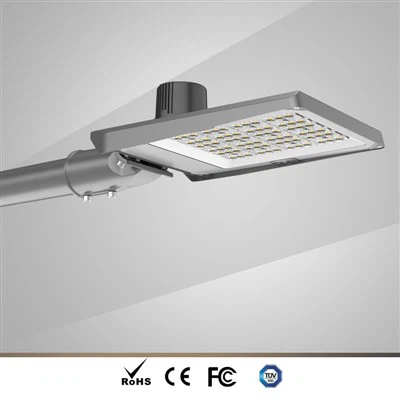
When it comes to smart street lights, it seems that there is not much market - "Most smart street light projects are not very profitable at present." said a company engaged in LED research and development. Is smart street light really a market that does not make money? For now, yes.
Since AlphaGo defeated the world champion in Go twice in a row, AI has been successfully "favored" by investors. Most investors believe that artificial intelligence will be fully and rapidly developed in the next few years. As long as they catch the express train of AI, they will also get more returns. The crazy behavior of investors has led to the emergence of AI bubbles. On the contrary, smart street lights are an industry that is well-received but not popular - for the development of smart street lights, companies do not have a unified development idea, and it involves a high degree of integration of other industries: in a smart street light, it is equipped with LED lights, WiFi modules, environmental monitoring, cameras, display screens, broadcast poles, alarms, chargers and other equipment.
Although these devices do not seem to have many advantages, lighthouses have become the most widely used "platform" for smart cities. With the advent of the IoT era, industries such as autonomous driving, 2K/4K monitoring, and environmental detection have entered a period of rapid development. How to deploy various types of equipment at the front end as much as possible has become a core issue. If the construction of base stations alone is not enough to support the huge number of IoT devices, the street lamps scattered all over the road will become the best choice - more precisely, the lamp racks.
The lamp rack is not a difficult or high-tech device, but in the IoT era, the lamp rack has the most concerned content of various companies: large number and power connection. Based on these two characteristics, equipment providers can install various types of equipment on the lamp rack: base stations, environmental perception, monitoring, edge computing servers and other equipment. The effective combination of such equipment will provide the most comprehensive data for city managers. It is worth noting that the development of smart cities is combined with finance and policies, and the comprehensive layout of smart cities through street lamps cannot be completed in the short term. For this reason, most smart street lamp providers choose to "enclose the land" first - once they win the bid for the street lamp project, they will have certain advantages when they need to be transformed in the future. But it cannot be ignored that even though there is a good development trend at present, smart street lamps have not entered a period of rapid development.
In various publicity, smart street lights are one of the core front-end devices for future urban development, and they will be equipped with various latest technologies and equipment; however, in actual development, smart street lights are more like "experimental fields" - too many unreliable factors make it impossible for smart street lights to develop as rapidly as other industries. The main problems are as follows:
1. Ownership issue: The main body of smart street lights is street lights, and street lights belong to the Municipal Engineering Management Bureau; once connected to wireless transmission such as WiFi or 4G/5G, it requires joint management by multiple departments such as telecommunications operators and environmental protection departments; if connected to monitoring equipment, it requires management by relevant public security departments... A small lamp pole requires management by multiple departments, which is tantamount to increasing the workload;
2. Profitability issue: In order to save expenditure, the government usually entrusts the construction to enterprises and gives them the right to operate for 5-10 years. For enterprises, there is currently only one way to make a profit - electricity bills.
In some projects, the management agency will use the electricity bills of the construction sections over the years as the payment standard for the enterprises, and the enterprises need to ensure the normal operation of the street lamps; in addition, some enterprises will have advertising revenue-based on the playback of the lamp pole screen, but it is undeniable that this effect is not obvious;
3. Management issues: Unlike other public projects, due to the ownership of the lamp poles, other brands cannot apply the project to the lamp poles: if the lamp poles are provided by company A, they will no longer use the universal standard interface or system, resulting in company B needing to rewire the lamp poles.
4. Engineering construction issues: Unlike other projects, the construction of smart lamp poles is not so "simple". In current use, it is usually divided into two types: cloud-based and localized. Different usage methods make the construction cost and later operation of smart street lamps different.
In order to realize cloud operation, smart street lamps must reconstruct the roads to achieve full networking of lamp racks. Some companies also use wireless networks such as 4G/5G/WiFi for control; localization is suitable for relatively simple street lamps, which only require the transformation of the original street lamps, and the operators need to manually adjust them in the later stage. These problems directly lead to the inability to quickly deploy smart street lamps.
In the field of smart street lamps, due to the low actual profit, there are relatively few companies in this field. But it is worth noting that although there are relatively few companies in this field at present, some technology giants are actively deploying them-such as Huawei. As we all know, Huawei, as a giant in the field of communications, has launched a comprehensive layout based on communications, and this is even more true in the field of smart cities-in Huawei's business, government and enterprises have always been Huawei's key layout. When Huawei actively participated in the construction of the city government and enterprise platform, it had realized the top-level design of smart cities, and smart street lamps were only a part of it. In Huawei's layout, perhaps smart street lamps are gifts, but peripherals are definitely sold in packages. "An industry insider commented.
But as far as the current development is concerned, smart street lamps have not entered the red ocean era, but are in the blue ocean-the blue ocean stage will also last longer.Luxsky Lighting's new smart street light has unlimited potential. Click the link to view it.https://www.luxsky-light.com/led-street-lights/led-high-power-modular-street-lights/high-power-led-modular-street-lights.html