A warehouse manager in Poland fitted eight UFO high bays across a 600-square-metre storage room. The ceiling sat 4.2 metres above the floor. The lights looked bright when he walked in, but the rack faces stayed dark and the aisles picked up glare from every angle. Nobody on the team had checked mounting height before ordering. The fixtures were built for a 9-metre hall, not a low concrete slab. What he actually needed was a proper warehouse ceiling light sized for a medium-height room. This guide covers the height bands, mounting methods, lumen targets, and IP or IK checks that keep a storage area even and readable.
Match the Fixture to Your Ceiling Height
The single biggest mistake is buying by wattage before the ceiling height is measured. A warehouse ceiling light behaves very differently at 3.5 metres than at 10 metres, and overshooting the height band usually means glare and wasted money.
For ceilings up to about 6 metres, the right choice is a low-profile warehouse ceiling light: a surface-mounted panel, a wrap-around strip, or a compact low bay. These spread light wide and keep the beam short enough to land on the rack face. Above 6 metres, the beam has to travel farther, and a standard warehouse ceiling light starts to fall off in lux. That is where you move to a high bay fixture, which carries a narrower beam and a taller lumens package. If your racks climb past 6 metres, check our high bay light category before you compare ceiling units.
A useful check: stand in the aisle and read the label height. If a standing worker's eye level sits well below half the ceiling, the space is almost certainly in the low-to-medium band.
Surface Mount, Suspended Mount, or Wrap-Around Strip
The mounting method decides how much clearance you lose and how fast the job goes.
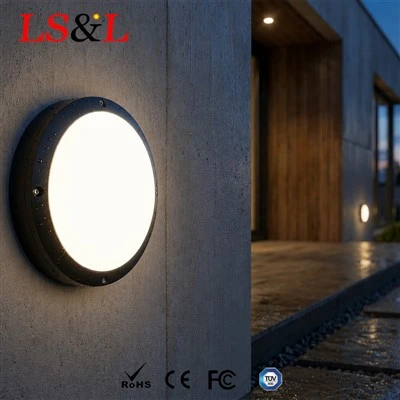
Surface mounting bolts the fixture straight to the concrete slab or metal deck. It works where the ceiling is solid and flat, and it leaves the least hanging height. A surface-mounted warehouse ceiling light fits rooms with sprinkler pipes, cable trays, or tight headroom that cannot spare a drop.
Suspended mounting uses a short chain, rod, or aircraft cable. It matters when the ceiling deck is uneven, when beams block the direct face, or when the fixture needs to sit below the pipework. A drop of 300 to 500 millimetres usually clears the services without changing the light distribution much. A warehouse ceiling light fitted too close to a solid beam loses half its spread to shadow, so check the clear face before you fix the bracket height.
Wrap-around strips and linear bars cover long aisles in one run. They suit picking rooms and packing lines more than deep-rack blocks. Round panels work for open storage bays where the light reaches in every direction. Pick the shape to match the aisle, not the other way around.
Lumens, Beam Angle, and Aisle Layout
Lumen targets start with where people actually read. Floor lux and rack-face lux are two different numbers, and the rack face is the one that matters most in a warehouse.
A warehouse ceiling light in a general aisle usually delivers 150 to 300 lux on the working plane. Picking and packing areas climb to 300 to 500 lux, because labels and small parts have to be read fast. Storage-only bays can sit lower, around 100 to 150 lux. A warehouse ceiling light that looks bright on the floor can still miss the labels on the rack face. Ask the supplier for the lux calculation per fixture and aisle width, not just a wattage figure.
Beam angle follows mounting height. Lower ceilings take a wider 100 to 120 degree spread to avoid pools of light between fixtures. Taller racks need a tighter angle that drives light down the rack column. Spacing should come from a layout sketch: fixture count, aisle width, and rack depth together.
IP and IK Ratings for Dusty or Damp Warehouses
Warehouses are dusty, and some are damp. The housing that survives an office showroom will not last a few years in a loading bay.
A dry, heated storage room usually manages IP20 to IP40. Unheated buildings, packing areas near washdowns, or warehouses on humid coasts should move up to at least IP54. Our IP65 LED ceiling lights handle dust and splashing water where the room is not fully sealed. For impact risk, look for an IK08 rating or better on fixtures that sit near loading doors, forklift routes, or racking where a falling box can reach the light.
A parts distributor in Thailand learned this the hard way. He ordered cheap plastic-housed ceiling units for a damp factory warehouse, and after one rainy season the covers warped and the drivers started tripping. The replacement moved to an IP65 metal-body unit, and the maintenance calls stopped.
Quick Answers on Warehouse Ceiling Lighting
How many lumens do I need for a warehouse ceiling light? General aisles take 150 to 300 lux, picking and packing 300 to 500 lux, and bare storage bays 100 to 150 lux. Ask for the layout lux, not just total lumens.
Can I use a high bay in a low warehouse? It can physically fit, but the beam is too narrow and the glare too high. Match the fixture to the height band instead of forcing a tall-rack product into a low room.
Is surface mount enough for a concrete slab? Yes, if the deck is flat and the fixture weight sits within the bracket rating. Use suspended mounts when beams or pipework block the direct face.
What IP rating does a dry warehouse need? IP20 to IP40 for heated dry storage; IP54 or higher for unheated, damp, or coastal rooms.
Do warehouse ceiling lights need emergency backup? If the space is a public workplace or multi-tenant building, local codes often require maintained emergency fixtures. Check the regulation before the order.
Sizing the Unit Before You Order
Sizing a warehouse ceiling light comes down to height, mounting, lux, and protection, in that order. Send the room dimensions, ceiling height, aisle width, and rack depth through our inquiry page, and we will match a ceiling unit to the layout rather than push a generic wattage. Our LED ceiling light range covers surface panels, strips, and IP65 units for indoor and damp storage areas.