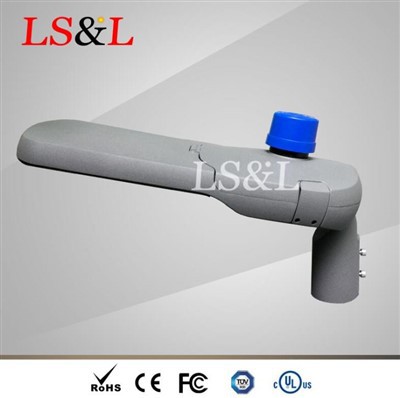
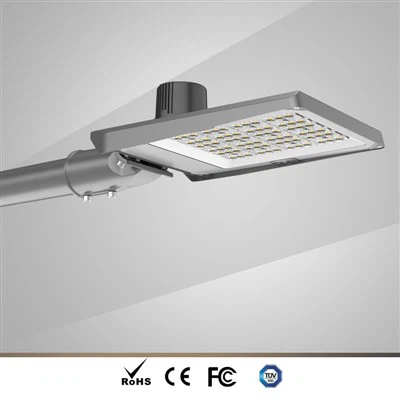
Frankly, after more than a decade in foreign trade, I've seen too many clients focus only on price and wattage when purchasing LED street lights. The result is often a string of problems after installation. Once an industrial park or municipal project chooses the wrong product, maintenance costs, complaints, and electricity bills all start to climb. These ten parameters are the ones you really need to get clear before placing an order.
First, luminous efficacy (lm/W). This is the core indicator of energy efficiency. Qualified LED street lights today typically reach 130 lm/W or higher; better ones hit 150 lm/W. Higher efficacy means less power for the same brightness. Don't be misled by rated wattage alone-some high-wattage lights have low efficacy and end up consuming more electricity.
Second, consider luminous flux and actual illuminance. Luminous flux is the total light output, but what matters more is the illuminance and uniformity once the lights are installed on the road. Ask the supplier for photometric curves and lighting simulations to confirm that main roads and intersections will meet the design requirements. Looking only at the flux number can lead you to products that waste a lot of light.
Third, color temperature. For industrial parks and road lighting, around 4000K is usually the most suitable. Too low and the light looks yellowish and outdated; too high and it becomes harsh and tiring. Some projects choose 6000K just to make the road "look brighter," only to hear complaints from drivers and security staff about glare.
Fourth, color rendering index (CRI). For road lighting, Ra70 or above is recommended; areas that need better object recognition are better at Ra80. Higher CRI makes road markings, vehicle colors, and obstacles clearer, which directly improves night-time safety.
Fifth, IP rating. Outdoor street lights should be at least IP65; in dusty or rainy industrial parks, IP66 is preferable. Inadequate protection lets water and dust in, and the lifespan of the fixture drops sharply.
Sixth, IK impact resistance rating. Street lights are installed along roadsides and can be hit by stones, branches, or light collisions. IK08 or higher is a safer choice, especially on lower poles or near active work zones.
Seventh, driver quality. The driver is the heart of an LED street light. Check the input voltage range, power factor (preferably 0.95 or above), and surge protection level. Voltage in industrial parks can be unstable; a poor driver often leads to batches of failures.
Eighth, heat dissipation design and materials. Good street lights use integrated aluminum alloy heat sinks with low thermal resistance, which slows lumen depreciation. Poor heat management raises the LED chip temperature and quickly reduces both lifespan and efficacy. A solid, evenly structured housing is usually more reliable.
Ninth, lifespan and lumen maintenance data. Don't just accept claims of "50,000 hours" or "100,000 hours." Ask for LM80 test reports and TM21 projections. Reliable products can keep lumen depreciation within an acceptable range after five to eight years of normal use.
Tenth, smart control compatibility. Many projects now require dimming, motion sensing, or remote monitoring. Confirm whether the fixtures support 0-10V, DALI, or wireless protocols and whether they can connect smoothly to existing or new intelligent systems. If they don't, future upgrades become difficult.
Among these ten parameters, efficacy, driver quality, protection rating, and heat dissipation are the most critical. Low-priced products often cut corners on exactly these points. Those of us in foreign trade know that clients fear large-scale failures within a year or energy savings that never materialize.
When purchasing, turn these ten items into a checklist and ask the supplier to provide data and reports for each one. It is far more reliable than simply comparing prices. Spell out the key parameters and warranty terms clearly in the contract to avoid trouble later.
If you are sourcing LED street lights for an industrial park or an overseas project and need help screening products against these parameters-or want to see how they work in real projects-just get in touch. I can share practical selection experience and the common pitfalls to avoid. Get the parameters right, and the project stays on solid ground.