

Yesterday, we explored how brightness and luminous efficacy influence the wattage needed for your LED floodlight. Today, let's start with an important question: how much area does a 100 watt LED floodlight cover?
Even if you buy a 100W floodlight, you might be unsure how far its light will reach. Installing it without considering coverage could result in one bright hotspot while leaving the corners in darkness.
The coverage of a 100W LED floodlight depends largely on its beam angle and mounting height. For example, a quality 100W fixture producing around 13,000 lumens, mounted at 15 to 20 feet with a wide 120-degree beam angle, can effectively illuminate approximately 1,600 square feet for general purposes.
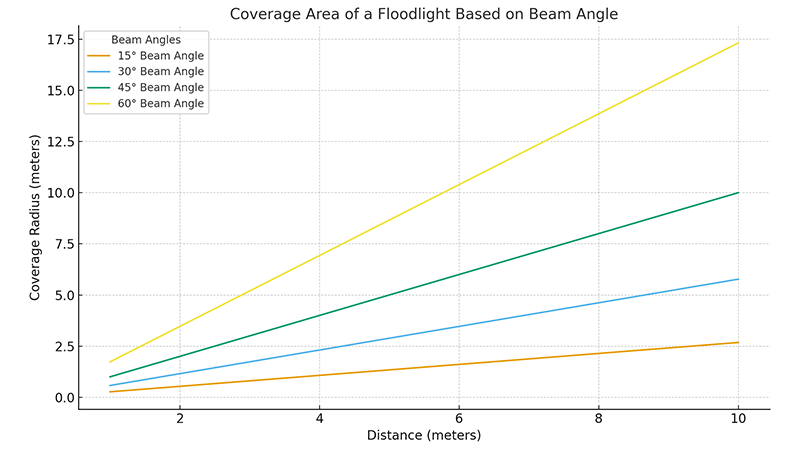
Beam angle is one of the most overlooked yet critical specifications for effective coverage. A floodlight does not simply project light in one direction. It distributes light in a specific pattern determined by the beam angle. Think of it like a hose nozzle: a narrow setting projects a concentrated stream a long distance, while a wide setting spreads water over a larger area close by. The same principle applies to LED lighting. The optics or lens of the fixture shape the light to achieve the desired beam angle.
Beam angle and mounting height work together to determine the final coverage area. Neither can be considered in isolation. For a high-quality 100W LED floodlight producing 14,000 lumens, the resulting coverage changes depending on height and angle as follows:
| Mounting Height | Beam Angle | Resulting Coverage Area (Approx.) | Best Use Case |
|---|---|---|---|
| 15 feet (4.5m) | 120° | 1,800 sq ft (167 m²) | Wide area lighting like a backyard or small lot |
| 15 feet (4.5m) | 60° | 450 sq ft (42 m²) | Focused lighting for a sign or building feature |
| 30 feet (9m) | 120° | 3,500 sq ft (325 m²) | Very wide, less intense light for ambient security |
| 30 feet (9m) | 60° | 1,600 sq ft (148 m²) | Strong, concentrated light from a higher pole |
As the table shows, a wider beam angle spreads light over a larger area, but the intensity on the ground will be lower. A narrower beam focuses the same amount of light into a smaller area, making it appear brighter. When clients ask about a specific wattage, the first questions we usually ask are: "How high will you mount it, and what are you trying to illuminate?" This ensures we can recommend the right optics for each project.
At Luxsky Lighting, we carefully design our LED floodlights with optimal beam angles and mounting recommendations to provide the right balance between coverage and brightness. Every fixture is tested to ensure consistent performance so that your space receives uniform, high-quality illumination.

If you would like to learn more about our LED floodlight range, please click https://www.luxsky-light.com/led-flood-light/led-modular-flood-lights/3030-led-modular-flood-lights.html . With the right beam angle, your lighting will be both effective and efficient, enhancing safety and visibility in every area.





