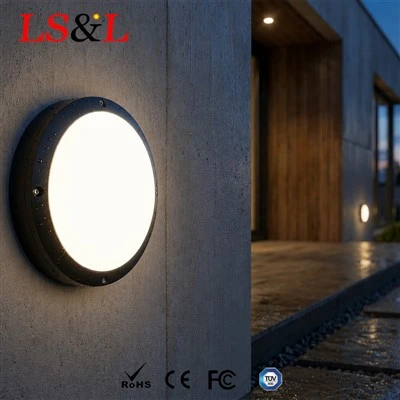
After more than a decade in lighting exports, factory clients often ask how many bulkheads an industrial walkway needs. Too few and the middle goes dark; too many and budget is wasted. Here is a practical way to estimate quantity, based on field experience.
Measure Length, Then Decide One Side or Two
Record the effective walkway length, mounting height, and width. A mainly pedestrian route can often use one side only; wider paths or runs with mid-line pipe obstruction often need two sides or local densification.
With basic dimensions in hand, counts for an led bulkhead light rest on calculation-not a round number guessed on site.
Derive Quantity from Spacing
Choose centre-to-centre spacing from lamp distribution, mounting height, and target uniformity, divide length by that spacing, then add points at ends and turns.
For example, effective length ÷ chosen spacing, adjusted for doors and junctions, gives the one-side count; for two sides, calculate each run. When a round bulkhead light is placed along the wall, also read spacing against the column grid so lamps do not sit in blind zones behind columns.
Match Lumens per Lamp to the Spacing
Wide spacing with low lumen output always leaves a dark mid-zone. Compare lumens and beam shape, not watts alone. On industrial walkways the aim is a clear view of floor and obstacles-steady uniformity beats harsh local brightness.
In dusty or humid conditions, protection must match as well-for example an IP65 bulkhead light-or the count may be right while dirt and depreciation dim the route quickly.
Add Allowance for On-Site Obstruction and Function
Stair entries, projecting equipment, corners, and loading crossings absorb light. Allow fill points in the estimate instead of dividing a perfect straight corridor once and stopping.
If the walkway is also an escape route, quantity and spacing must follow the emergency and fire design-not daily appearance alone.
Practical Estimation Steps
- Measure length, height, and one-side versus two-side layout
- Choose a spacing range from distribution and height
- Length ÷ spacing, then add ends and turns
- Fine-tune for obstruction and door openings
- Lock the count after a night walk on a sample run
How many bulkheads an industrial walkway needs is set by length, spacing, output per lamp, and real obstruction. Calculate first, install a sample, then confirm-safer than buying a full count in one step.
From years of working with factory and export clients, I know lamp count is both calculated and walked. Combine the numbers with a night check and the walkway stays even.

If you are estimating bulkheads for an industrial walkway, share length, mounting height, and one-side or two-side layout. I can help identify which bulkhead light fits better and set a realistic quantity range.