

Many overseas cold storage clients struggle with light source selection and cannot decide between LED tri-proof lights and traditional fluorescent lights. The two fixtures perform very differently under low-temperature working conditions. Having completed numerous cold chain foreign trade projects, I will compare them in terms of energy consumption, durability and maintenance to help you pick the right option for cold storage.
1. Comparison of luminous performance at low temperatures
Sub-zero cold storage environments pose a tough challenge for light sources. Traditional fluorescent lights start slowly and suffer severe luminous efficiency loss in low temperatures, failing to reach the designed brightness. Tri proof lights are engineered for harsh environments. They deliver reliable cold start performance and slow lumen depreciation. Even with continuous long-time operation inside cold storage, they can steadily maintain target illuminance without gradual dimming.
2. Differences in energy consumption and heat emission
Fluorescent lights have low luminous efficiency and generate considerable heat. Extra heat increases the workload of refrigeration compressors and pushes up cooling electricity bills indirectly. IP65 LED tri proof light offers higher luminous efficacy with lower power draw for the same brightness level. It produces little heat and brings no extra burden to the cold storage cooling system. Cold storage runs 24/7 all year round, so the gap in power costs becomes significant over time. Linear installation of these fixtures along long narrow aisles delivers even illumination and minimizes dark spots.
3. Service life and on-site maintenance costs
Fluorescent tubes have a short lifespan. Replacing lights in cold storage is costly: workers must operate in freezing zones, and partial shutdowns may be required in some cases. Broken tubes also carry risks of dust and hazardous substance leakage. Weatherproof LED batten light features an integrated sealed structure that resists condensation and frost. Its service life far exceeds fluorescent lamps. Longer replacement intervals greatly cut expenses on spare parts, labor and operational downtime, leading to lower long-term maintenance costs.
4. IP rating and environmental resistance
Standard fluorescent light fittings have low ingress protection ratings. In cold storage with high humidity and recurring condensation, circuits easily get damp and short-circuit, causing high failure rates. Frost and moisture inside cold storage corrode internal components quickly. LED tri-proof lights come with tightly sealed housings for dust and water protection, suitable for cold, humid cold storage conditions and reducing the risk of short-circuits. Fluorescent lights are only fit for dry, normal-temperature workshops instead of harsh cold storage environments.
5. Payback period and overall TCO analysis
Fluorescent lights have a lower upfront purchase price. However, when calculating total cost of ownership over the whole lifecycle, their high power consumption and frequent replacements mean electricity and maintenance expenses will surpass LED solutions within several years. Fluorescent lights may be acceptable for small temporary cold storage with limited operating hours. For commercial cold storage running nonstop long-term, LED tri-proof lights show overwhelming advantages.
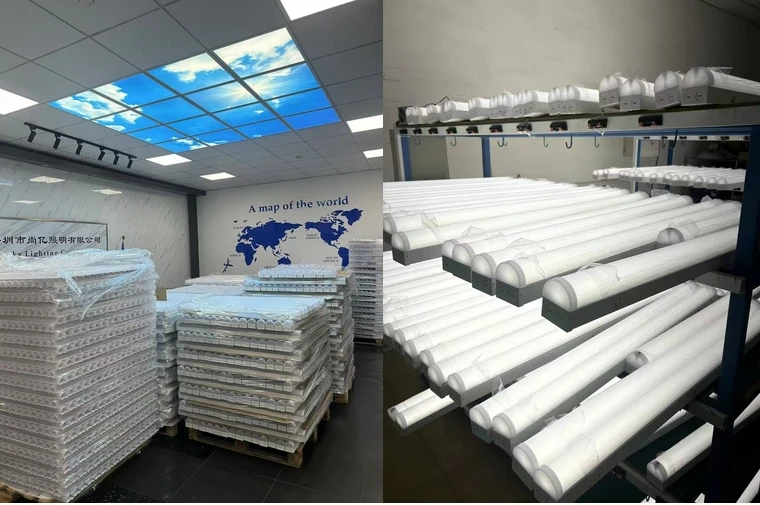
To sum up, fluorescent lights can be considered for short-term temporary use, while LED tri-proof lights are the top choice for long-term commercial cold storage projects. We can run lighting simulation and energy consumption comparison calculations according to your cold storage dimensions and operating hours. If you are selecting light sources for your cold storage project, feel free to share your warehouse details and get a free fixture comparison proposal.





