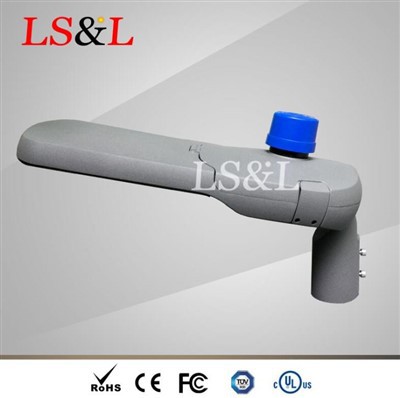
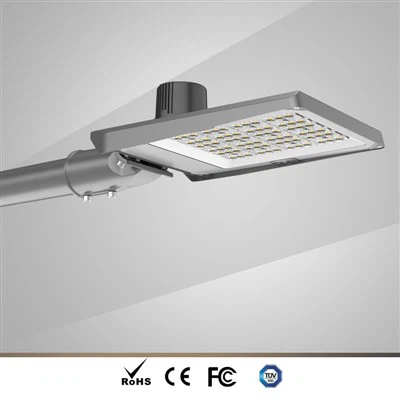
Working in LED lighting export for years now, one of the questions I get asked most often is: "This is a 100W fixture, so why is your housing noticeably bigger than the competitor's? Are you inflating the wattage?" Honestly, that question has it backwards. At the same wattage, a bigger fixture with more heat dissipation surface isn't a red flag - it's usually a sign that the thermal design was actually built to match the power output. Let's break down what's really going on here, based on years of hands-on sourcing and factory-side experience.
What Fixture Size Actually Tells You at the Same Wattage
When an LED chip operates, most of the electrical energy converts into heat, and only a small portion becomes visible light. The higher the wattage, the more heat is generated - and that heat has to be carried away through heat sinks, cooling fins, or a die-cast aluminum housing. If it isn't, the LED junction temperature exceeds its safe threshold, lumen depreciation accelerates noticeably, and in worse cases the chip fails outright. So at the same rated wattage, a fixture with a larger body and denser heat sink fins usually means more available dissipation area, which keeps junction temperature in a safer range - and that translates directly into a longer usable lifespan.
On the flip side, if a 100W street light is built noticeably smaller than comparable products on the market, and there's no special thermal engineering involved (such as a vapor chamber, heat pipes, or liquid cooling), it's very likely that thermal margin has been sacrificed to produce an impressive-looking spec sheet based on short-duration performance data. Over time, that typically shows up as accelerated lumen depreciation and a higher failure rate. This is exactly why the saying in this industry holds true: "at equal wattage, compare thermal design; only at equal thermal design does size become a meaningful comparison."
How to Properly Evaluate Heat Dissipation Area - Not Just Fixture Size
New buyers often fall into the trap of assuming bigger housing automatically means better cooling. In reality, there are several more technical factors worth evaluating.
Look at Effective Heat Sink Surface Area, Not Overall Volume
At the same housing footprint, a fin design with tighter spacing and a well-optimized layout can offer two to three times more surface area than a flat-panel design. What actually matters is the real air-contact surface area once the fins are unfolded - not the fixture's overall length, width, and height. It's reasonable to ask the factory directly for heat sink surface area calculations or a thermal simulation report.
Check the Material and Manufacturing Process
Die-cast, one-piece aluminum housings generally outperform welded or thin-wall stamped assemblies, because a continuous, unified structure creates a shorter thermal path and lower thermal resistance. During sourcing, it's worth requesting material test reports and wall-thickness data - a heat sink with an impressive footprint but overly thin walls will still have limited actual heat-conduction capacity.
Review Junction Temperature Test Reports and Lumen Depreciation Curves
The most direct and hardest-to-fake evidence is an LM-80 report combined with a TM-21 projected lumen depreciation curve, along with real measured junction temperature data under full-load operation. Junction temperature needs to stay within the safe range specified by the LED chip manufacturer - only then does a rated lifespan of 30,000 to 50,000 hours mean something beyond a number on paper.
Measure Surface Temperature and Airflow Design On-Site
Where possible, it's worth running a continuous full-load lighting test on a sample unit, using an infrared thermometer to measure surface temperature at the housing and at the base of the heat sink fins, while also checking whether the airflow design supports effective convective cooling. These details reveal true thermal performance far more reliably than external dimensions alone.
A Few Recommendations for Buyers
Fixture selection shouldn't come down to price and appearance alone - the real differentiator is the substance behind the thermal design. At the inquiry stage, it's worth explicitly requesting third-party lumen depreciation test reports, junction temperature test data, and material certification for the heat sink. Factories that can readily provide this full set of documentation typically have stronger R&D capability and quality control, which translates into lower risk for long-term partnerships.
Conclusion
At equal wattage, a fixture's thermal design deserves far more attention than its physical size alone. A genuinely reliable cooling solution is the result of materials, structure, and test data working together - not something achieved by simply making the housing bigger. As a team focused on LED street light export, Luxsky Lighting runs junction temperature testing, lumen depreciation testing, and full-load thermal validation as a standard part of the R&D process for every street light we develop, so the wattage on the spec sheet holds up under both third-party testing and years of real-world use.
If you're sourcing an LED street light supplier with dependable thermal performance and stable lumen output for your project, feel free to reach out to the Luxsky Lighting team - we're glad to share detailed test reports and put together a thermal design recommendation tailored to your project.