

When selecting LED flood lights, most people tend to focus on brightness or power consumption, but often overlook a critical factor - color rendering. The Color Rendering Index (CRI) determines how accurately a light source reveals the true colors of objects compared to natural sunlight. A flood light with a high CRI can make architectural details, landscapes, and outdoor scenes look vivid and realistic, while a low CRI can make even beautiful designs appear dull or lifeless. To understand how this works, let's take a closer look at what CRI actually does and why it matters in outdoor lighting.
You often see "CRI" listed on lighting specifications, but what does it really mean for your project? Ignoring it can easily lead to poor lighting choices that make even the most beautiful buildings or landscapes look flat and uninspiring.
The Color Rendering Index (CRI) measures how accurately a light source displays the true colors of objects compared with natural sunlight. It is rated on a scale from 0 to 100. The higher the number, the more faithfully the colors appear. Lights with a high CRI bring out vibrant, natural tones, while those with a low CRI can make everything appear dull or distorted.
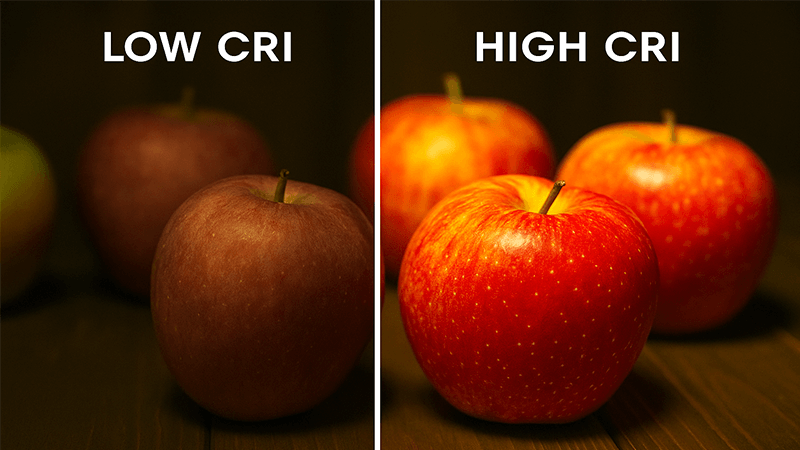
Think of sunlight as the ideal benchmark for color accuracy, earning a CRI of 100. Traditional incandescent bulbs also score close to this perfect standard. For LED flood lights, the CRI value indicates how close the light comes to reproducing natural color. This index is determined by comparing how eight standard pastel colors (R1–R8) appear under the test light versus a reference source, and the average of these results is expressed as the general CRI, written as "Ra."
However, there is another important factor many overlook: the R9 value. R9 measures how well a light reproduces deep, saturated reds. This is crucial for applications such as highlighting brick walls, wood textures, skin tones, and plants. Many flood lights with an overall CRI of 80 may have a poor R9 value, making reds appear brown or lifeless. For projects where color accuracy and vibrancy matter, a strong R9 score is essential.
In outdoor environments, CRI plays a key role in enhancing visual quality. Whether it is used for architectural lighting, landscape illumination, or commercial areas, high-CRI LED flood lights improve depth, texture, and realism, making spaces appear more appealing and inviting.
Below is a general guide to help you understand CRI levels and their typical applications:
| CRI Value (Ra) | Light Quality | Typical Application |
|---|---|---|
| 90+ | Excellent / Museum Quality | Art galleries, high-end retail, medical exams |
| 80–90 | Good / High Quality | Commercial projects, quality residential, offices |
| 70–80 | Fair / Basic Quality | Street lighting, parking lots, industrial warehouses |
| <70 | Poor | Not recommended for most modern applications |
By understanding these CRI ratings, you can select LED flood lights that not only illuminate your space but also enhance the natural beauty and accuracy of colors in your project.
At Luxsky Lighting, we deliver the best LED flood lights with reliable quality and long-lasting performance, providing dependable solutions for a wide range of outdoor projects. Choosing Luxsky Lighting means choosing outdoor flood lights you can trust for both performance and durability.

If you are interested, please click https://www.luxsky-light.com/led-flood-light/led-modular-flood-lights/3030-led-modular-flood-lights.html.





