

A certificate tells you a product passed. The test report tells you what was tested, on which model, under which conditions and with what result. Buyers who collect only certificates can still end up with an LED bulkhead light that gives less light than expected, leaks after the first wash-down, or loses brightness early.
This guide lists the test reports to request from an LED bulkhead light supplier, what to look for in each, and how to check that a report is real.
Certificate vs Test Report: Why You Need Both
A certificate is usually one page that says "compliant". A test report carries the test conditions, the measured data, the sample model numbers and the laboratory details. For CE, the formal document is the manufacturer's Declaration of Conformity, and the test reports are the evidence behind it.
Two gaps show up again and again. The tested sample passes, but the production units are different. Or the model number on the report is not the product that arrives. Make sure the same model number appears on the report, the nameplate and your quotation. On larger orders, ask for a pre-shipment inspection or a third-party random test on production units, and compare the result with the reference sample.
Which Test Reports to Request
|
Report |
What it proves |
What to check |
|---|---|---|
|
LM-79 (with IES or LDT files) |
Luminous flux, efficacy, colour temperature, CRI and light distribution of the complete luminaire |
Tested power and CCT setting, efficacy figure, laboratory name |
|
LM-80 and TM-21 |
Lumen maintenance of the LED source and projected lifetime |
L70 or L80 hours, test temperature and drive current, which LED was tested |
|
LVD (EN 60598) |
Electrical safety |
Standard numbers, model range, laboratory |
|
EMC (EN 55015, EN 61547) |
Electromagnetic compatibility |
Standards used, pass results, model range |
|
RoHS |
Restricted substances |
Laboratory, report date, product covered |
|
IP (IEC 60529) |
Dust and water protection |
Test conditions, cable glands fitted, mounting position |
|
IK (IEC 62262) |
Impact resistance |
Impact energy, tested sample |
Photometric and Lifetime Reports
LM-79 is the report lighting designers use. It should come with IES or LDT files so the data can go straight into design software. If the LED bulkhead light has adjustable power or selectable colour temperature, confirm which setting was actually measured.
LM-80 covers the LED source only. Luminaire lifetime also depends on the driver and the thermal design, so do not treat the two as the same number. TM-21 limits how far lifetime can be projected beyond the LM-80 test hours, so a long lifetime claim needs enough test data behind it.
Safety, EMC and RoHS Reports
These are three separate reports. LVD covers electrical safety, EMC covers electromagnetic compatibility, and RoHS covers restricted substances. In each one, look at the standard numbers, the laboratory, the report date and whether the model range includes the product you are ordering. Test reports do not usually expire, but standards are revised, so ask for reports made against current editions.
IP66 and IK10 Test Reports
An IP report must show both the dust test and the water test, with conditions and results. A photo of a label is not enough. A real IP66 report records the powerful water-jet test and states whether the sample was tested with cable glands fitted and in its intended mounting position.
The IK10 report confirms resistance to impact. For projects near the coast, ask for the polycarbonate diffuser's UV-resistance data, and a salt-spray test where the site calls for it.
How to Verify a Test Report Is Real
Start with the laboratory and ask whether it is accredited to ISO/IEC 17025. Then check the report number and the applicant name, which should be the factory or supplier you are dealing with. Always ask for the original PDF, never a screenshot. Where the laboratory has an online lookup, search the report number there, and compare the model on the report with the nameplate on the physical sample.
Treat these as red flags: an applicant that is a different company, a model range that does not include your model, results measured at a different power setting, or a report made against an outdated standard.
What We Provide with Our LED Bulkhead Light
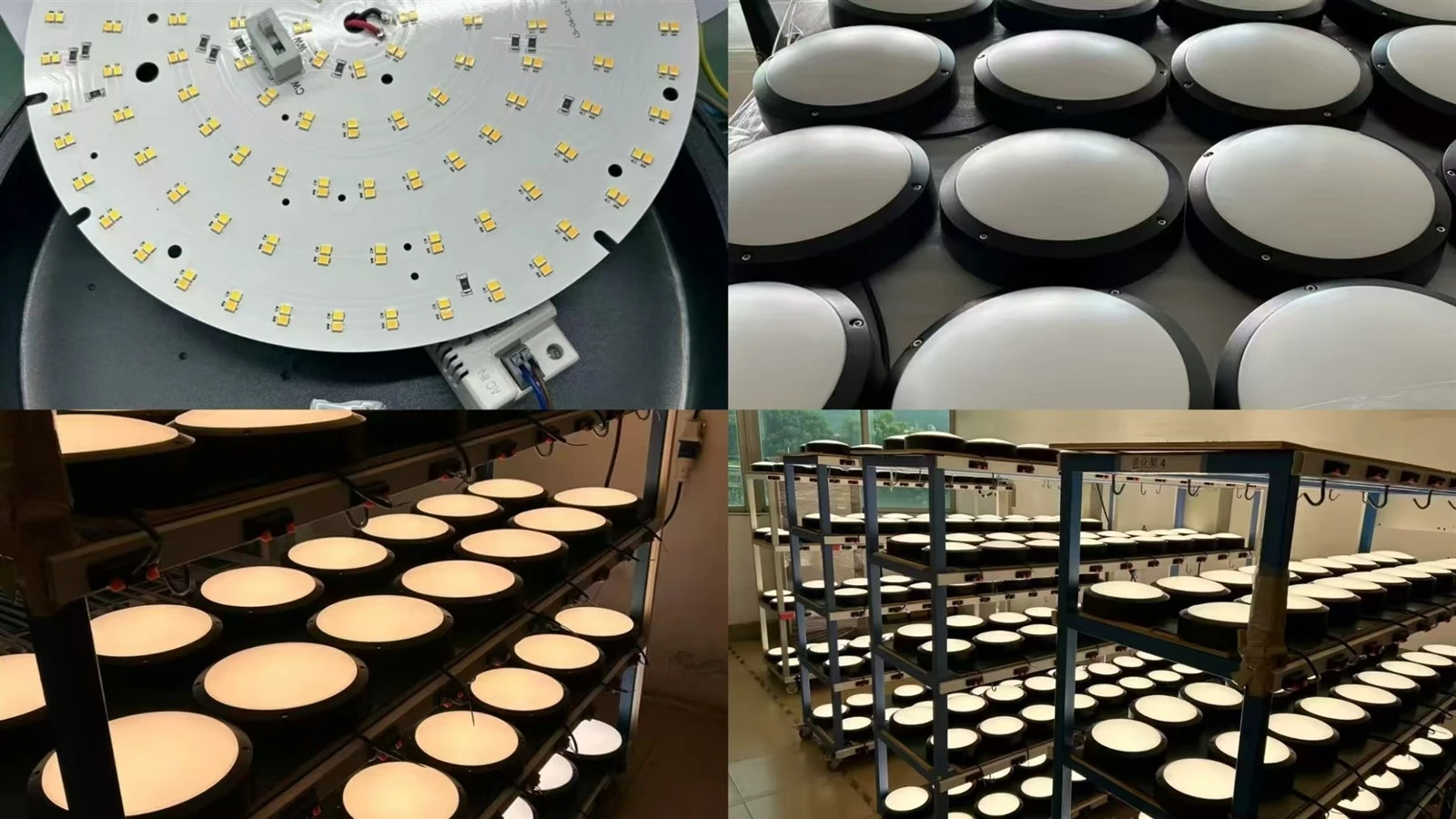
For our LS-04-CL-275-DW we supply the full CE, RoHS, IP66 and IK10 test reports. Power (15-24W) and colour temperature (3000K, 4000K or 6000K) are adjustable, so please check that the report covers the settings you will use. Other documents can be provided when customs or project approval requires them.
See the specifications on the product page: https://www.luxsky-light.com/led-ceiling-lights/3cct-led-bulkhead-light-275mm.html.
Ask for the reports at the quotation stage, while a mismatch is still easy to fix. Tell us your target market and we will reply within 24 hours with the test reports for our LED bulkhead light.





