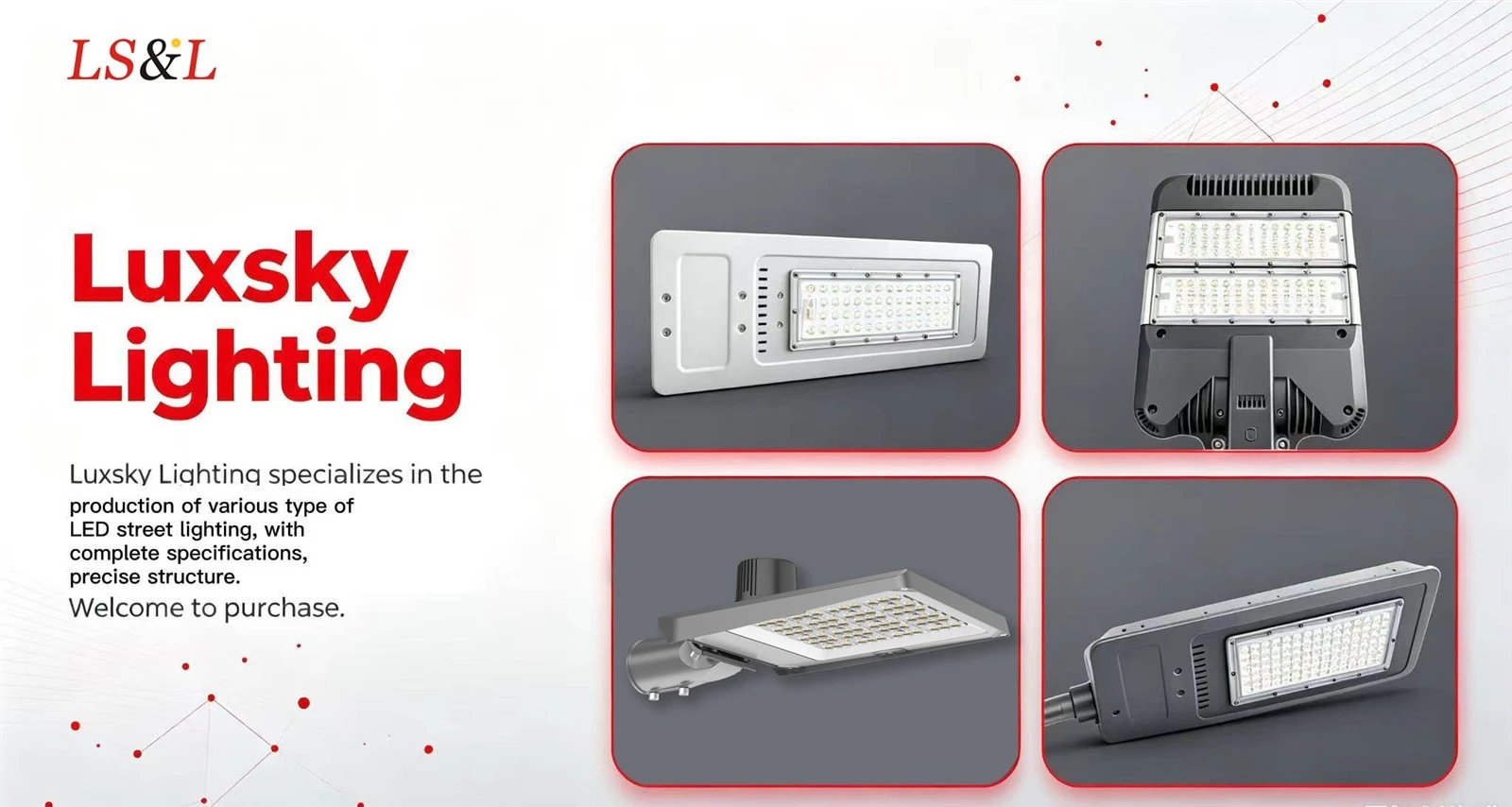
As an LED street light manufacturer with more than twelve years of export experience, I have supplied lighting to logistics parks, ports and industrial zones in the Middle East, Southeast Asia, Africa and South America. Many buyers compare wattage and price, but forget to ask about the beam type. In my experience, the wrong beam pattern is one of the most common reasons for dark gaps, glare and wasted electricity. Here is how I explain T2, T3 and T4 to my customers.
Type II (T2): Narrow Roads and Walkways
A Type II beam is long and narrow. It spreads light mainly along the road, with limited coverage to the sides. This makes it a good choice for narrow branch roads, staff walkways, and service lanes, usually within 6 to 10 meters of road width. With fixtures of 60W to 120W on 6 to 8 meter poles, LED street lights for logistics parks with a T2 beam give even light along the route without wasting energy on buildings or fences. If the road is wider, T2 will leave the far side dark.
Type III (T3): Main Roads and Truck Lanes
A Type III beam is wider and projects light forward and to the side. It is the most popular choice for trunk roads, heavy truck lanes and gate approaches, especially when poles are placed on one side of the road. With 120W to 200W fixtures at 8 to 12 meters, pole spacing of about 3.5 to 4 times the mounting height gives good uniformity. For these busy roads, T3 is usually my first recommendation.
Type IV (T4): Open Areas and Boundary Edges
A Type IV beam has a semicircular pattern, so it is designed to light a wide area in front of a pole, while the back side stays dark. This makes it useful along building edges, fence lines, loading aprons, parking lots and the edges of container yards, where you want light to fall inward and not outside the site. For wide open areas, 150W to 300W on 10 to 12 meter poles is common. A driver in a high truck cab can be dazzled, even for two seconds, so check glare with simulation, especially for T4 near reversing zones.
Do Not Choose by Habit: Confirm with Simulation
Beam type works together with pole height, spacing and road width. A T3 beam on a narrow road wastes light, and a T2 beam on a wide road leaves dark spots. For large crossroads or open yards, Type V may be better than T4. Always ask your supplier for real IES files and run a DIALux simulation before ordering. Combined with smart dimming and motion sensors, a correct beam choice saves even more, since quality LEDs already use 50% to 70% less electricity than old metal halide lamps.
Choose a Supplier Who Stands Behind the Product
A beam pattern only works if the optics are accurate and the fixture lasts. Replacing one light on a 10-meter pole means hiring a lift, closing a lane and losing working hours, so I suggest an LED lighting supplier with 5 year warranty and a real factory behind it. As an LED lighting OEM manufacturer, we also customize wattage, beam angle, color temperature and branding for project buyers and distributors. Our quality standards include:
- Branded LED chips and drivers, 100% aging test before packing
- Die-cast aluminum housing, IP66 / IK08, 6kV to 10kV surge protection, CE and RoHS certified, with real IES files and test reports for DIALux design
When a customer asks me for a 5-year warranty, I can say yes with confidence, because we test before shipment, not after complaints.
Conclusion
Use T2 for narrow branch roads and walkways, T3 for main roads and truck lanes, and T4 for open areas and site edges, all confirmed by simulation. Our LED street lights are built with strict quality control, so they stay bright, stable and reliable for years.
If you are planning a new logistics park or upgrading an old one, choose Luxsky Lighting. Contact us today for a free DIALux layout and a competitive quote.