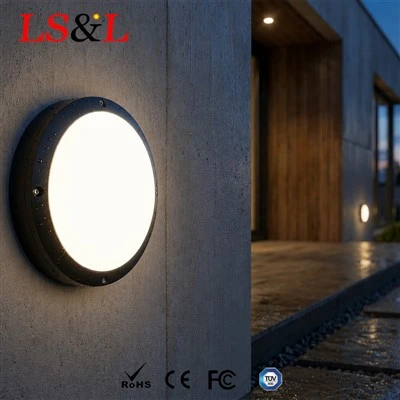
Many overseas factory clients ask whether industrial bulkhead lights support both wall and ceiling mounting. Having worked in lighting foreign trade for years, I've seen buyers overlook mounting options before ordering, only to face structural mismatches on site and delay the whole project. Below I share key selection tips and practical notes from real projects.
1. Check factory design for dual mounting compatibility first
Not every led bulkhead light works for both wall and ceiling installation. Some models feature a simple base made for wall mounting only. Dual-fit versions come with two sets of pre-drilled holes and balanced internal weight distribution. Always refer to the datasheet to verify centre of gravity and cable entry direction for both orientations. If the structure is not designed for ceiling mounting, forced installation will lead to tilting and loose seals over time.
2. Site conditions for different mounting styles
Wall mounting is the standard setup for these fixtures, ideal for side lighting along corridors. For damp and dusty areas, an IP65 bulkhead light should be fitted with cable glands pointing downwards to stop moisture wicking along cables. Ceiling mounting is common in utility rooms and underground storage spaces. The sealing gasket bears pressure differently in this orientation, so only pick models officially rated for ceiling installation.
3. Differences in beam angle and illuminance layout
The same bulkhead light delivers totally different lighting results depending on how it is mounted. Wall-mounted units spread light horizontally to light up long aisles, while ceiling-mounted ones cast light straight down for compact zones. Use photometric data to calculate lux levels during design. Do not reuse wall mounting layouts directly for ceiling applications. For emergency variants, confirm escape route illumination meets local fire codes in both installation positions.
4. Critical construction notes
Even dual-fit fixtures need proper installation. Wall-mounted units should be placed out of reach of forklifts and foot traffic. For ceiling mounting, double-check ceiling load capacity and add adaptor brackets if the panel is weak. Pay attention to cable entry orientation. If the gland faces upward on ceiling installs, condensation or water can run into the fixture and damage the driver. Lay the gasket flat and tighten screws evenly in a diagonal pattern.
5. Scenarios where mixed mounting is not advised
For wash-down zones and exposed exterior walls, I normally recommend wall mounting instead of ceiling mounting. Topside positions collect standing water and condensation, accelerating ageing even with a high ingress rating. For microwave sensor models, mounting orientation changes detection coverage. Always test sensing range and hold time after installation.
6. Ordering and selection advice
Confirm base hole drawings, IK ratings and photometric performance for both mounting positions with your supplier. Do not assume all models support dual installation; many low-cost options are built for wall mounting only. If your project requires a mix of wall and ceiling points, choosing compatible dual-fit models simplifies stock management and reduces fixture SKUs.

If you are designing factory lighting layouts and unsure which positions suit wall or ceiling mounting, send your site drawings and operating conditions over. I can build a matched lighting plan and avoid mounting non-compliance issues.