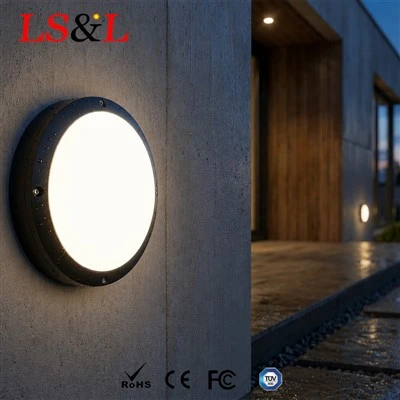
After more than a decade in lighting exports, factory clients often ask how sensor bulkheads actually work in industrial buildings-and whether they really save energy on quiet routes without constant false triggers. Here is how motion-sensor bulkheads operate in industrial settings, and where they fit best, based on field experience.
Basic Principle: Detect Movement, Then Raise Light
A sensor bulkhead integrates a detector in the luminaire or a matched module. When someone enters the detection zone, the lamp switches from off or a low level to full output; after the person leaves and a set hold time expires, it returns to off or a minimum level.
When an led bulkhead light is used on plant link corridors, this "full when occupied, low when empty" logic uses less energy than full output all night.
Common Detection Types: PIR and Microwave
Passive infrared (PIR) senses moving body heat and suits relatively open routes; late switch-on can occur when the view is blocked. Microwave is more sensitive to movement and may react through thin doors or light partitions, but sensitivity should be reduced where vehicles or pipe reflections cause false triggers.
On industrial sites, choose the detector type after checking whether the route has many doorways and mixed vehicle traffic.
Hold Time, Sensitivity, and Photocell Need Joint Commissioning
Too short a hold leaves people in the dark while still on the route; too long limits the saving. Sensitivity should cover normal walking speed without frequent triggers from nearby machine heat or distant vehicles.
Products with a photocell can stay quieter when daylight is already enough. When a round bulkhead light is mounted along the wall, aim the detector toward the walkway and keep it clear of obstructions for more stable results.
Where They Fit Better in Industrial Buildings
Sparse link corridors, storage support routes, and stairs with little night use usually show clearer energy benefit. On main escape routes that require a minimum illuminance under code, use "low glow plus full output when occupied" rather than simple full-off.
If sensors are used at outdoor vestibules or semi-outdoor points, match protection to the site-for example an IP65 bulkhead light-so moisture does not affect the detector and driver.
Use and Maintenance Points
- Confirm which zones allow sensor control under applicable rules
- After install, test detection by walking and by vehicle where relevant
- Clean detectors and covers regularly; dust lowers sensitivity
- Replace failed lamps promptly so a whole run does not lose its logic
Motion-sensor bulkheads in industrial buildings switch brightness by detecting people or movement, which cuts empty-hour load on low-traffic runs. The principle is simple; real performance depends on location, parameter set-up, and protection matched to the site.
From years of working with factory and export clients, I know whether sensor lights save energy depends on putting them in the right places and setting them correctly. When the route choice is right, both the bill and complaint levels improve.

If you are assessing sensor bulkheads for plant routes, share route type, traffic pattern, and whether vehicles share the path. I can help identify which bulkhead light fits better and lock a clear sensor scheme.