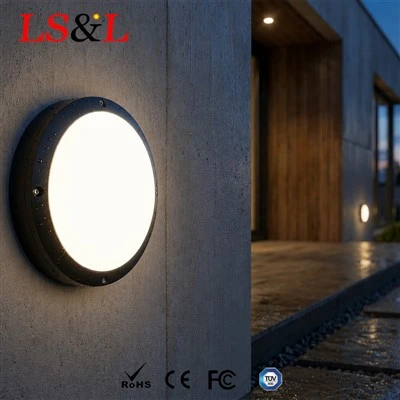
After more than a decade in lighting exports, factory clients often ask how to choose emergency bulkheads for industrial staircases. Stairs are critical escape routes-if the type or position is wrong, treads are hard to read when power fails. Here are the main selection points for emergency bulkheads on industrial stairs, based on field experience.
Confirm Maintained Type and Emergency Duration First
Follow the fire design for maintained or non-maintained operation and the required emergency duration. Stairwells often use maintained types so daily and emergency lighting share the same luminaires; where separate daily lighting already exists, non-maintained types may be used as designed.
Emergency data on an led bulkhead light must match the drawings-not a generic "with emergency" label without duration and type.
Keep Treads and Landings Continuously Visible
Emergency illuminance is usually lower than normal, so large dark zones matter more. Mounting height and spacing should serve the tread surfaces and landings; add points at turns to limit column shadows and blind corners.
When a round bulkhead light is spaced regularly on the stair side wall, it often forms a continuous band of light and helps people see where to step after supply failure.
Match Protection and Impact Resistance to the Industrial Setting
Stairs linking to workshops or basements often see dust and humidity; flights near exterior doors also take weather. Set IP rating by real exposure-on damp or semi-outdoor sections consider an IP65 bulkhead light or higher.
On low mounting heights or stairs beside logistics routes, impact-resistant covers help keep emergency function after accidental contact.
Plan Installation, Indication, and Testing Together
Wiring and mounting must not break the seal; test buttons or self-test status should be easy to reach on patrols. Stair emergency luminaires belong on scheduled function and duration tests, with a point log.
Coordination with escape signage should be clear in the design so the scheme is not "light only, no direction."
Selection Checklist for Industrial Stair Emergency Bulkheads
- Maintained / non-maintained type and emergency duration
- Even visibility on treads and landings, with fill at turns
- IP rating and sealing for dusty, humid, or exterior-linked sections
- Impact resistance and mounting height
- Test method, log, and acceptance criteria
Choosing emergency bulkheads for industrial stairs centres on compliant type and duration, continuous tread visibility, protection matched to the site, and testing that can be proven and managed. Stairs are not ordinary corridors-emergency provision must follow escape-route rules.
From years of working with factory and export clients, I know stair emergency lighting is for the critical moment. Saving a little in normal operation matters less than specifying it correctly once to code.

If you are fitting emergency bulkheads on plant stairs, share stair location, whether flights link outdoors, and the design duration. I can help identify which bulkhead light fits better and lock the selection conditions clearly.