

Lighting in food factories often runs for long hours; many workshops operate almost around the clock, so electricity forms a noticeable part of operating costs. Traditional tubes consume more power and depreciate quickly. Switching to LED tri-proof lights usually brings clear savings. Here's a practical view of the scale of savings and how to estimate them, based on project experience.
Higher efficacy is the main source of savings
For the same illuminance, LEDs draw significantly less power than conventional fluorescent tubes.
A typical LED tri proof light used in food plants delivers high efficacy, so total installed power can often fall by 40 % to 60 % while still meeting target brightness-the most direct reduction in energy cost.
Long operating hours magnify the difference
Many areas in food factories are lit for 12 hours or more each day; some approach 24-hour operation. The longer the lights stay on, the greater the annual gap created by lower wattage. Savings per fixture become substantial over a year, and the plant-wide total is even more noticeable.
Slower lumen depreciation also saves energy indirectly
Traditional tubes lose output quickly, forcing earlier replacement or extra fixtures to maintain levels. LEDs depreciate more slowly, and well-protected products hold their output better in humid conditions.
When a weatherproof LED batten light is installed above production lines, brightness stays more stable over time and reduces the waste of "dimming then adding more lights."
Adequate protection avoids extra consumption
Food plants require frequent wash-down. If fixtures fail because of water ingress, repair costs rise and temporary extra lighting may increase energy use.
Selecting a product that meets the standard of an IP65 LED tri proof light lowers both failure-related energy waste and maintenance expense.
Simple estimation method
Record the total power of the existing lights and daily operating hours to calculate annual consumption. Recalculate with the total power of the new LED scheme; the difference is the annual energy saving. Multiply by the local electricity price to obtain the yearly cost reduction. Most food factories recover the fixture investment within one to three years.
Actual savings depend on the efficiency of the old system, daily running hours and electricity price. Plants with long operating hours and inefficient existing lights usually see the strongest results.
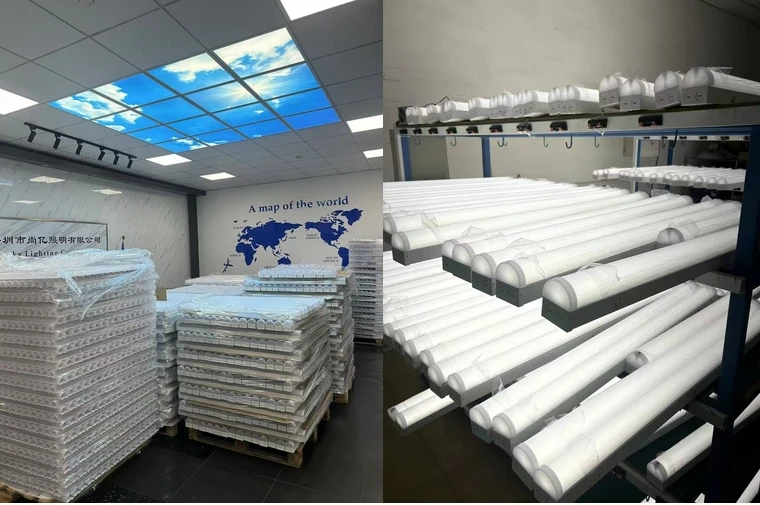
If your food factory is evaluating a lighting upgrade, share the current fixture wattages, quantities and daily operating hours. I can help estimate the saving potential and payback period based on experience. Lower energy costs make long-term operation noticeably easier.





